Two white openings sit inside a black rectangle. Add a narrow white corridor between them and they become one connected opening. That change sounds simple, yet it alters the route through the composition without requiring either main opening to move. The paired original drawings make the connection small enough to inspect, including the amount of black it removes. This is a study of authored shapes, not a tested claim about how every viewer organizes an image.
Keep the field and the two openings fixed
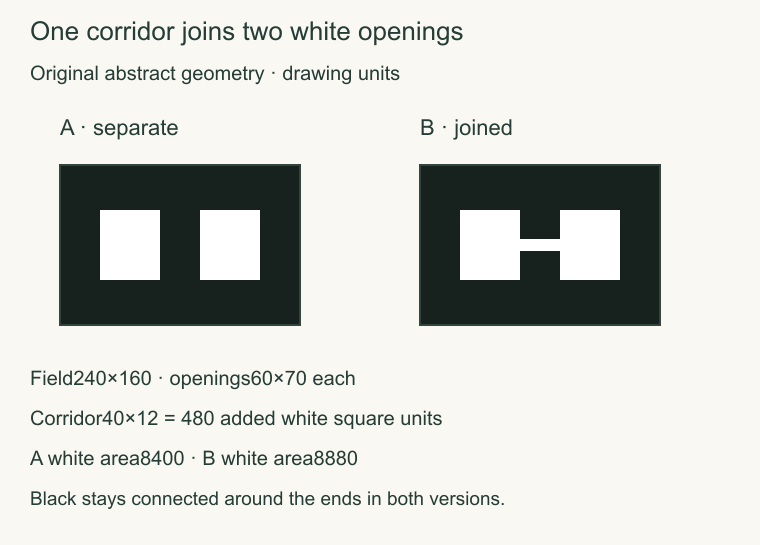
Use a black field 240 units wide and 160 units high. Inside it, place a white rectangle from x40 to x100 and y45 to y115. Place a second white rectangle from x140 to x200 over the same vertical span. Each opening is therefore 60 by 70 units. Both remain well inside the black outer boundary.
In version A, leave the 40-unit strip between x100 and x140 entirely black. The white regions do not touch one another or the outside edge. One can describe two separate enclosed openings without deciding that they stand for windows, people or any named object. Those associations would introduce another interpretive layer.
Change only the connecting strip
For version B, copy the field and both rectangles without resizing or moving them. Add a white corridor from x100 to x140 and y74 to y86. Its width is 40 units and its height is 12. It meets both rectangles along their facing edges, so a path can now pass through white from either opening into the other.
The corridor adds 480 square units of white. The original two rectangles together contain 8,400; B contains 8,880. Its added connection is not an area-neutral rearrangement. Calling the drawings identical except for connectivity would conceal that numerical change. What stays fixed is the field, the two large rectangles and their positions; the corridor is the single addition.
Trace the opening and the remaining black
In A, tracing either white boundary brings you back to that opening without reaching its neighbor. In B, a continuous white route runs through the corridor. My attention shifts from two repeated blocks toward the constriction between them. The narrow passage can become the compositional event even though it occupies far less area than either large opening.
Now follow the black above and below the corridor. Both remain connected around the outside ends of the white shape. The added passage does not split the entire black field into two disconnected pieces, because it does not extend to the field's edges. This distinction prevents a loose description of everything being divided when only the internal white regions have been joined.
Let the words name the actual relationship
Getty defines negative space in relation to the area around primary objects. In this abstract study, I treat the white as openings within the black field; another description could treat the white forms as the primary shapes. State that choice rather than assuming black always means object and white always means absence.
I prefer A when the separated repetition is the subject and B when I want to emphasize a link with a narrow middle. Those preferences belong to these drawings. A practical next variation would change the corridor's height while holding its position fixed, then recalculate its added area. That keeps the inquiry concrete instead of asking a small graphic to prove a universal law of perception.
Sources & further reading
Published sources for the details and examples discussed in this story.