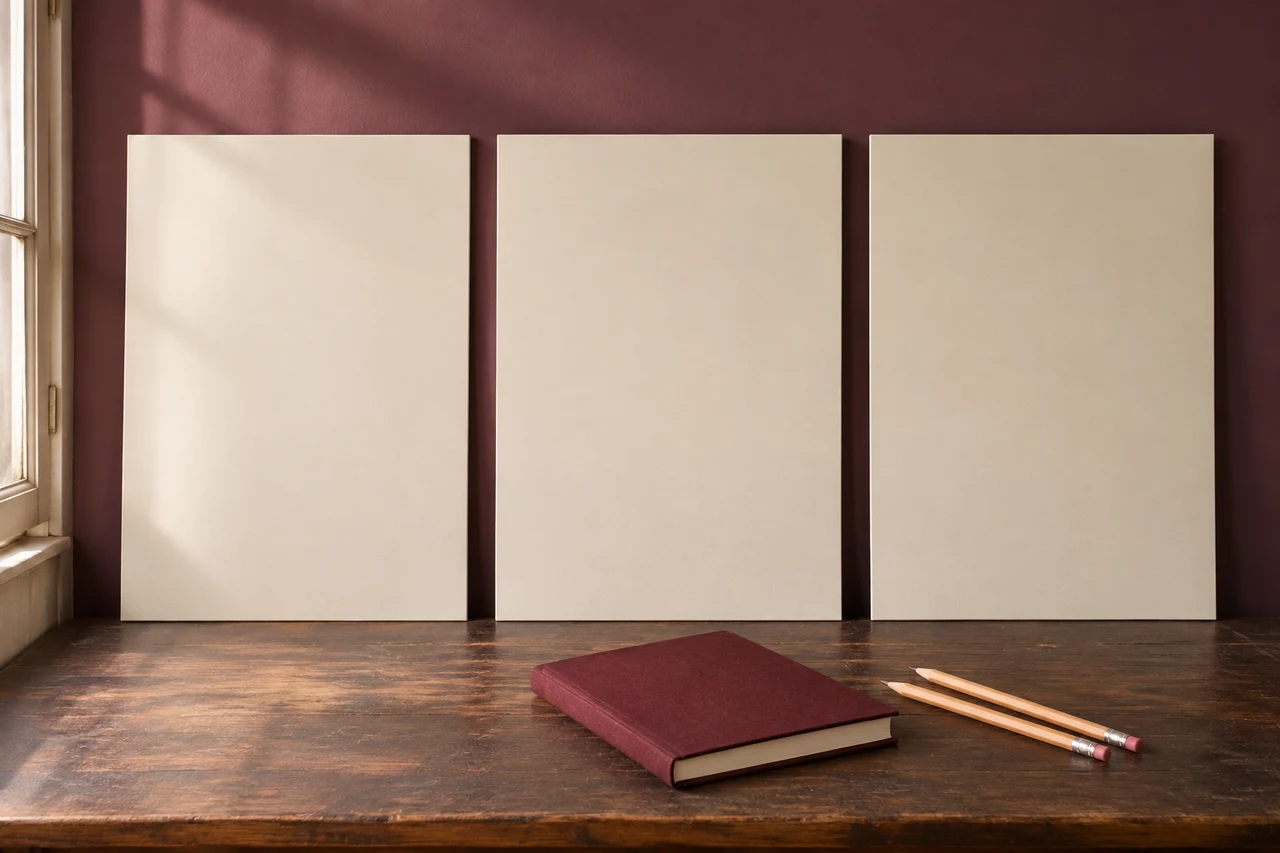
Three images beside one another can ask to be read as a single work, but their gaps still matter. The National Gallery defines a triptych as a painting made in three sections, usually with wings beside a central panel; some have hinges that let the wings close. That structural description gives us a starting point for an original imagined composition, without borrowing a museum painting or assuming every trio of prints is a triptych.
Keep one complete proposal in view
Imagine three equal upright cream panels arranged left, center and right with matching narrow gaps. A black disk sits low on the left panel. A red vertical rectangle occupies the middle of the center panel. A second black disk sits high on the right panel. These are the complete invented image elements, not a copied artwork, a physical model we made or a documented exhibition.
Read the three sections together first. The two disks repeat a form while changing its height. The red rectangle interrupts that repetition at the center. I would follow a rising relationship from left disk to right disk, with the middle shape acting as a pause. That is my proposed reading of these declared forms, rather than a measured response every viewer must share.
Let the gaps preserve a useful hesitation
The cream ground does not become one physically continuous sheet across the gaps. Each section has its own edges, even while the repeated disks invite comparison across the arrangement. I find that interruption useful: it makes moving between forms an act of looking rather than pretending that the three surfaces are one uninterrupted field.
Now imagine each panel seen alone. The left disk can become a low-weighted composition, the center rectangle an isolated vertical emphasis, and the right disk a high-weighted one. Their separate descriptions are possible, but they lose the outer-panel repetition and the center's role between two neighbors. The difference concerns this authored arrangement, not a rule that an individual triptych panel can never be discussed independently.
A different order changes the question
Move the red rectangle to the left in a second imagined arrangement, leaving the two disk panels in the other positions. The emphatic color now begins the sequence rather than occupying its middle. I would read that version as an opening accent followed by a comparison, while the first makes the color an interruption between related outer forms.
No section has been repainted in this thought experiment, yet its neighbors have changed. Keep the original order with the work when order is part of the intended composition. A retailer's three matching frames cannot supply that intention by themselves, and this exercise makes no claim about an actual artist's private meaning.
Check what an edition actually includes
If considering a multi-part print, establish whether the listing represents one complete work, one section of a work or three independent images. Check the named edition, included pieces, dimensions and stated arrangement. Ask about framing and hanging requirements for the actual objects rather than use our paper proposal as installation advice.
The National Gallery's account concerns a historical painting structure, including the possibility of hinged wings; it does not say every contemporary three-part arrangement folds or serves the same purpose. This feature reproduces no museum artwork or catalogue image. The useful habit is to look at the relationships among the sections before paying for a finish that might obscure what the set is meant to contain.
Sources & further reading
Published sources for the details and examples discussed in this story.