An outline need not be equally dark or continuous for a figure to remain available to the viewer. The Met’s published image of John Singer Sargent’s Figure Study provides a particular place to look at that difference. Two original line-only studies then make a much simpler question explicit: what do I supply when one segment is absent? This is a reading of an actually viewed image and new drawings, not a claim about Sargent’s intention or an experiment measuring visual perception.
Begin with the drawing that is actually available
The Met identifies Figure Study as graphite on off-white wove paper, dated about 1910, object 50.130.127 verso. The displayed image we viewed is 429 by 600 pixels. It shows a bending figure with a clearly described head, an arm and hand near the chest, and a leg extending toward the lower part of the sheet. That resolution supports a broad contour reading, not close examination of graphite deposits or paper condition.
In the published view, some boundaries near the shoulder and upper body appear darker and more continuous than portions of the lower leg. Toward the bottom, short and faint marks do not make a uniformly closed enclosure. I nevertheless read the marks as belonging to a continuing leg and foot-like end rather than as unrelated strokes. This is my inference from the image, not proof of what every viewer sees.
The record establishes the artist, medium and object identity. It does not tell us that each faint or absent segment was intentionally left for a viewer to complete. Image reproduction, the drawing’s state and working decisions cannot be separated merely by looking at this small display. I would therefore describe the visible difference before proposing any reason for it.
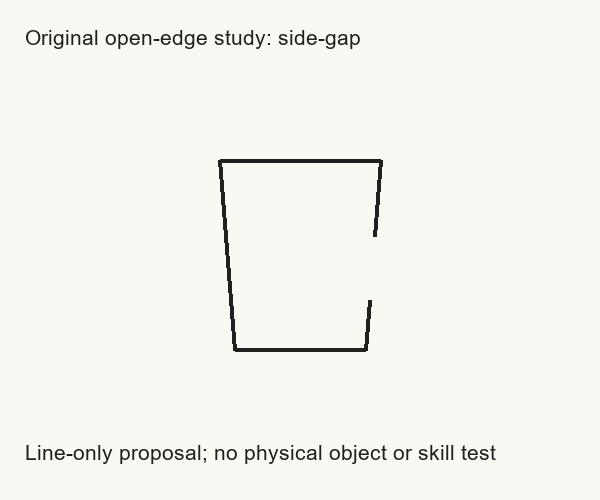
First original study: an opening in the side
The first new study uses a simple tapering four-sided outline that I read as vessel-like. Its top and lower edges remain, along with the entire left side, but the right side has an intentional gap in its middle. There is no shading, surface decoration or recognizable product. Unlike the Sargent image, the missing segment here is explicitly part of our own drawing plan.
I imagine the right boundary continuing between the two visible ends. The long neighboring edges and the intact base contribute to that reading. Another reader could instead treat the gap as a literal opening in a flat graphic object. That alternative is useful: the image offers cues without supplying a mandatory three-dimensional identity or material.
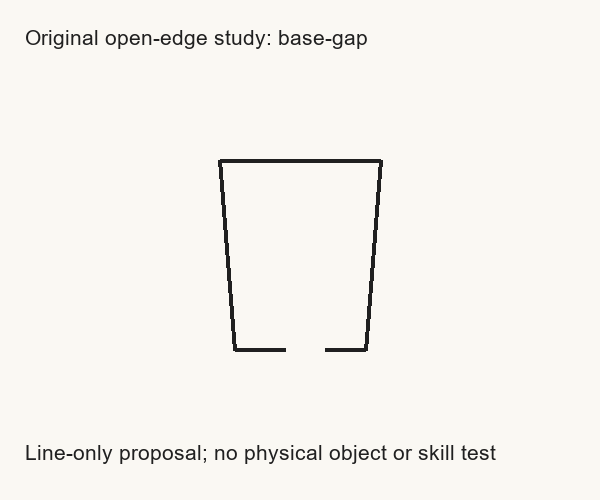
Second original study: move the missing segment
The second study keeps the same overall outline but closes the side and leaves a shorter gap near the middle of the base. I read the lower corners as giving the absent base a likely direction. The shape still seems available to me, but now the interruption belongs to its apparent resting edge rather than its side.
That change interests me because the missing portion has a different job. A side gap interrupts the enclosure; a base gap asks me to connect two lower horizontal pieces. Neither drawing has been put before an audience or converted into an actual vessel. Their differences are visible graphic proposals, not evidence of a law about how incomplete objects are recognized.
Use an incomplete edge as a question, not a shortcut
Getty’s formal-analysis guide explains that lines often define form boundaries. These studies ask how much of one particular boundary I choose to imagine when the marks stop. They do not teach that fewer lines automatically make a drawing more sophisticated, and they do not turn a small Sargent reproduction into instructions for copying his working method.
For a personal drawing project, I would keep an untouched version before choosing to omit a segment. That lets the decision remain a comparison rather than an irreversible claim that the missing line must improve the picture. An ordinary drawing tool can investigate the question without a new specialist set. If reproducing an institution’s image publicly, its specific rights still need separate checking; our two original diagrams do not confer permission over the source drawing or photograph.
Sources & further reading
Published sources for the details and examples discussed in this story.