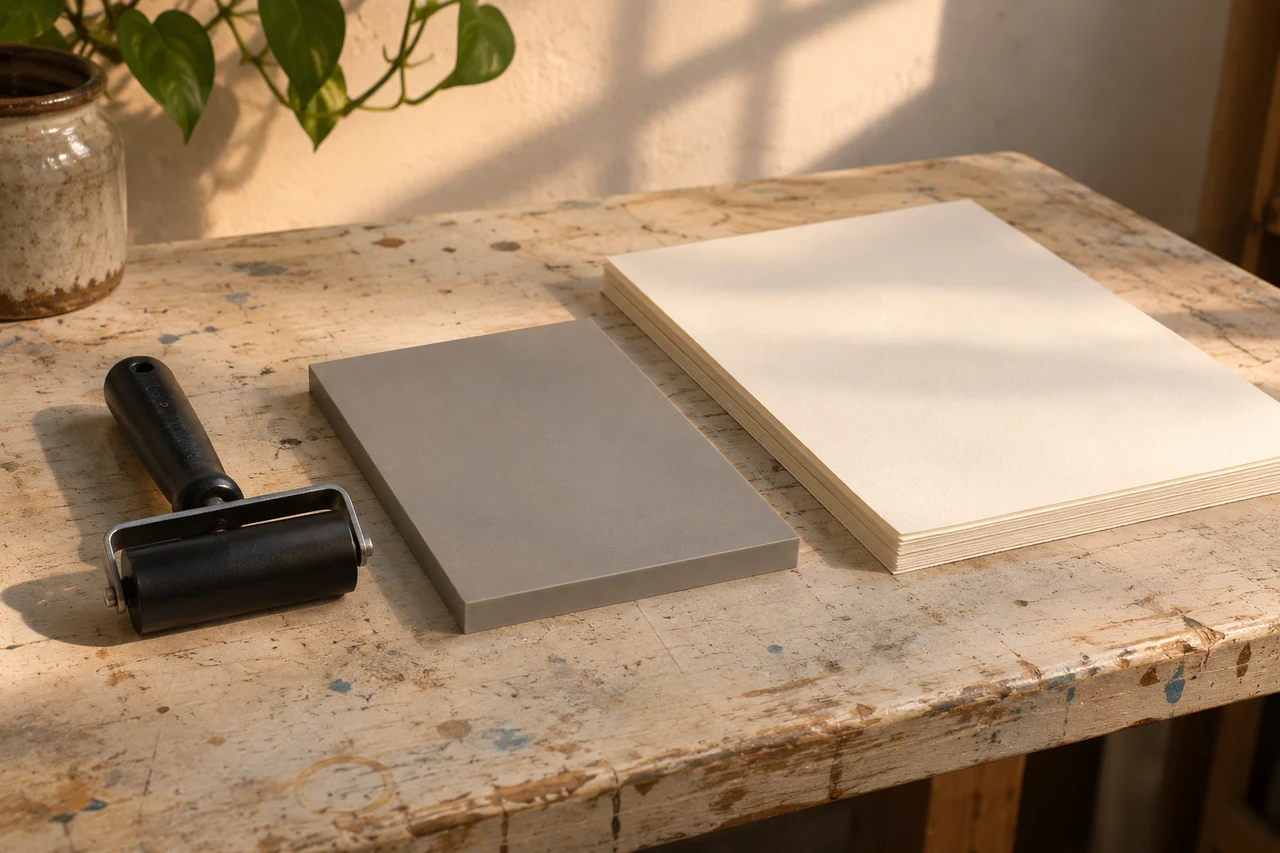
A dark mark in a print can invite the habits of reading a pen drawing: perhaps the artist simply drew that line. Linocut asks for another relationship between surface and result. The National Portrait Gallery describes a cut linoleum surface that is inked with a roller and impressed on paper or fabric. Its raised, uncarved areas take most of the ink; deeper carved lines take less. That reversal can change the questions a viewer brings to a printed shape.
Begin with the surface that remains
The Gallery's glossary places cutting before inking and impression. The account connects the eventual print to both the remaining raised surface and the areas removed from it. A visible shape is therefore worth considering in relation to what remained available for the roller, rather than assuming every dark line corresponds to a groove.
This is a reading of the documented process, not a report from a studio or an examination of the Gallery's illustrated artwork. No museum image is reproduced here, and no specific mark in that image has been identified. The distinction can be discussed without pretending to have handled the block or watched its printing.
Imagine one simple relationship
For an original conceptual example, imagine a circle left raised within a surround that has been cut lower. In the glossary's account, the raised circle is the surface expected to receive most ink relative to the deeper surround. The imagined circle is not a carving pattern, finished print or instruction to operate a sharp tool.
The useful change in attention is from an outline to an area. What looks like a positive shape in the impression can depend on material left in place. The surrounding recession also contributes to that relationship, even if a viewer first notices only the stronger printed shape. This is an interpretation of an invented arrangement, not a claim about an artist's intention.
Leave room for the actual impression
The source says that deeper carved lines take less ink; it does not give us a promise that every recessed area in every impression must be perfectly white. Keep that more limited description. Neither a thumbnail nor this imagined circle identifies the exact block, pressure, inking or surface condition behind an actual work.
When considering a print for a wall, look for the seller's documented medium and accurate details for the individual item. Ask whether a description identifies a linocut impression or a reproduction of another image. Surface-process vocabulary can make the enquiry more specific, but it does not establish authenticity, edition size, condition or value.
The reward of the distinction is visual rather than a ranking of techniques. A raised area and its cut surround offer a different account of making a mark from a pen moving across paper. Keep the actual work's evidence beside that idea, and allow the documented process to sharpen attention without replacing looking with a guessed studio story.
Sources & further reading
Published sources for the details and examples discussed in this story.