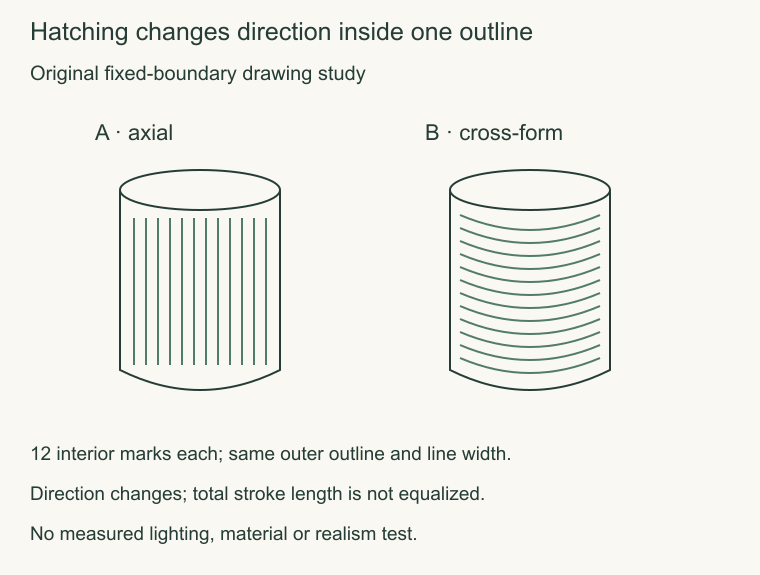
The outline says cylinder before any interior mark is added. What can a small set of lines contribute after that? In this original drawing study, one version puts straight strokes along the cylinder's length and the other bends strokes around its width. The point is to make the marks describe different directions inside the same boundary, rather than claim that one drawing is objectively more realistic.
Give the two studies a shared boundary
Imagine an upright cylinder drawn as a flat diagram: a top ellipse 160 drawing units wide and 40 high, two vertical sides 180 units long, and a curved lower edge. Copy the complete boundary for both studies. These units describe the authored figure, not a measured household object or a perspective formula for every cylinder.
Leave both studies uncolored, use the same dark line width and add twelve interior strokes to each. Do not introduce a cast shadow or a darker right side in only one version. Those would be additional changes. The comparison needs enough common material that we can point to mark direction rather than silently crediting a different outline or light source.
Study A follows the long axis
In A, distribute twelve straight vertical strokes through the interior. Stop them short of the top and bottom boundary so that they remain interior marks rather than extra outer edges. In the figure they run parallel to the long sides, without converging toward a vanishing point.
I read these strokes as emphasizing the cylinder's upright extension. Their repeated direction echoes the sides. They might also suggest a ribbed surface in another drawing, which is why I would not describe them as a neutral statement of smoothness. They supply a direction to inspect, not a guarantee that the viewer sees a particular material.
Study B turns around the width
In B, replace the straight strokes with twelve shallow curved strokes distributed down the interior. Each has its ends higher than its center, echoing the lower half of the top ellipse. Keep the outer contour exactly as it was in A. The interior marks now cross the long axis instead of running beside it.
The curves invite me to follow the surface around a rounded form. That is a different descriptive proposal from lengthwise strokes. It is not a full model of light falling on a cylinder: their spacing, width and darkness do not establish a measured tonal gradient. Equal stroke counts also do not mean equal total ink or equal visual weight, since the stroke lengths differ.
Use the comparison to choose a question
Getty's formal-analysis vocabulary distinguishes line direction from the two-dimensional shape and three-dimensional form that a drawing may describe. Our fixed boundary and changed interior marks turn that distinction into one controlled comparison. The institution's artwork examples have not been traced or reproduced.
For another attempt, keep A and B beside the blank boundary and ask where your eye travels within each. If you want to explore tone next, make that a separate study with declared changes to spacing or density. Do not add cross-hatching only to B and then report that curvature alone created every difference. One modest drawing can be useful when it makes the next artistic decision more precise.
Sources & further reading
Published sources for the details and examples discussed in this story.