A print need not belong to a numbered group of identical-looking sheets, and a date beside its title need not be the date every impression was printed. Two MoMA records make those differences concrete. Degas's Green Landscape is described as a unique monotype. Morandi's Large Still Life with Coffeepot is an etching in an edition of forty, with printing divided between two later years. Reading those facts together opens a question about how a printed work takes shape over time.
Start with the two exact records
The first is Hilaire-Germain-Edgar Degas, Green Landscape (Paysage vert), object19.1996. MoMA dates it about1890, lists the medium as monotype on paper, names Degas as printer and marks its edition unique. The date remains approximate; the record does not give us a particular day at the press.
The second is Giorgio Morandi, Grande natura morta con la caffettiera (Large Still Life with Coffeepot), object96.1955. Its heading says1933, half the edition printed1943 and the other half printed1949. The medium is etching; publisher and printer are both Calcografia Nazionale, Rome; the edition field says40. Preserve the complete date statement rather than reducing it to the first year.
Unique describes this monotype, not a failure to print enough
MoMA's monotype definition describes applying paint or printing ink to a flat plate of metal, glass or plastic to make a unique print. That process vocabulary helps explain why the word unique is not an incomplete edition fraction. For this Degas record, the medium and edition field agree on singularity.
I find that a useful change in attention. Instead of asking which numbered copy came first, I would ask how a particular printed surface emerged from the artist's work on the plate. That is a question suggested by the process, not a claim to have examined this sheet or identified individual fingerprints. The online record's contextual essay discusses Degas's experimentation, but its artwork image has not been used as a visual demonstration here.
Morandi separates making a composition from printing its edition
The Morandi heading makes three years relevant rather than one. Its wording identifies an earlier1933 work and two later printing groups,1943 and1949. The record does not assign the museum's individual impression to one of those groups in the fields used here. I would leave that question open rather than calculating a date from an imagined edition number.
The accompanying MoMA publication excerpt describes Morandi's meticulous hatched and cross-hatched lines and says many of his etchings were editioned later at Calcografia Nazionale. That is an attributed account of process and working history, not our own microscopic examination. It makes the repeated act of printing part of the work's history without making the later impressions mere mistakes in dating.
Compare production relationships without ranking value
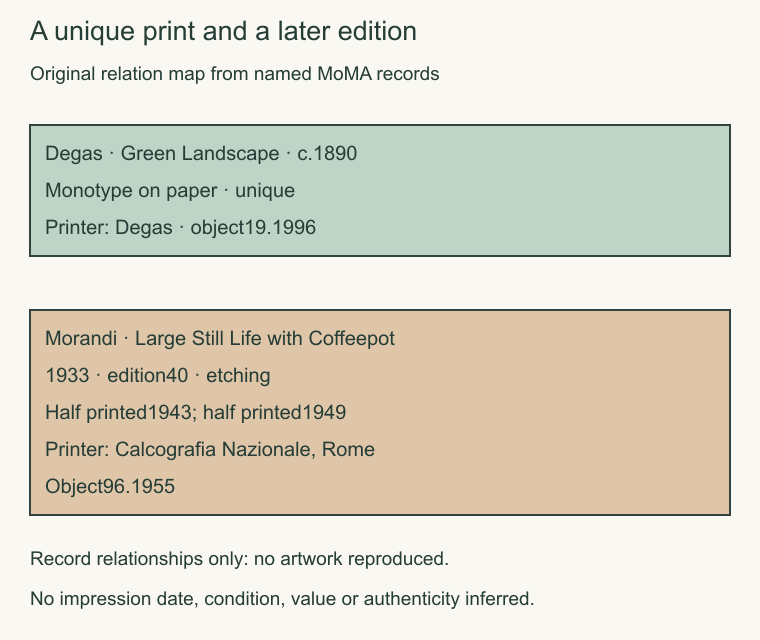
Our small original diagram keeps the two relationships separate: Degas, monotype, unique, printerDegas; Morandi, etching, edition40, printing1943and1949, printerCalcografiaNazionale. It does not reproduce either composition or pretend that forty boxes would establish the whereabouts or condition of forty surviving sheets.
The comparison would change the question I bring to a collection label. For the Degas, the named process explains the singular print. For the Morandi, the expanded date reveals that an edition can have a production history beyond the composition's first year. Neither establishes price, quality, authenticity or a permission to reproduce the artwork. The reward is a more exact account of what kind of making the record actually describes.
Sources & further reading
Published sources for the details and examples discussed in this story.