Put ‘I’m nobody! Who are you?’ on a magazine cover and the question acquires another speaker. Is the magazine introducing itself, challenging the passerby, or lending its largest type to a poem? Dickinson’s first line can carry all that uncertainty before a reader reaches the smaller source line. The two original covers here explore that change of address. They are proposals for a reading feature, not existing issues. Their subject is Life, I in Poems, Series Two, as transcribed in Project Gutenberg 2679: an eight-line poem whose invitation to a companion ends by making public self-announcement look dreary.
Read the invitation past its first question
The first line contains both a declaration and a question. The speaker calls themself nobody, then turns toward ‘you.’ The next line asks whether that addressee is nobody too. It does not begin by announcing a large movement or a universal community. The possibility is smaller and more particular: another person might answer in the same terms. This reading follows that changing relation rather than treating nobody as a ready-made slogan for everyone who feels overlooked.
The third line makes a pair out of the possible recognition, then immediately asks for secrecy. That reversal matters to a cover editor. The first question can sound open and inviting when isolated, while the next instruction restricts what should happen to the connection. In this witness, the fourth line says they would ‘banish us.’ The unnamed they remains outside the pair. I read that threat as a reason the little alliance cannot simply be enlarged into a public membership campaign.
The second stanza turns from the pair to the prospect of being somebody. Being somebody is called dreary, and publicity is compared with a frog telling its name through the ‘livelong day’ to an admiring bog. The admiration does not rescue the performance. The repeated naming seems exhausting within this contrast. All eight lines therefore complicate a triumphant cover about becoming famous: the closing audience is present, but its attention is hardly an uncomplicated prize.
Cover A lets the first person occupy the page
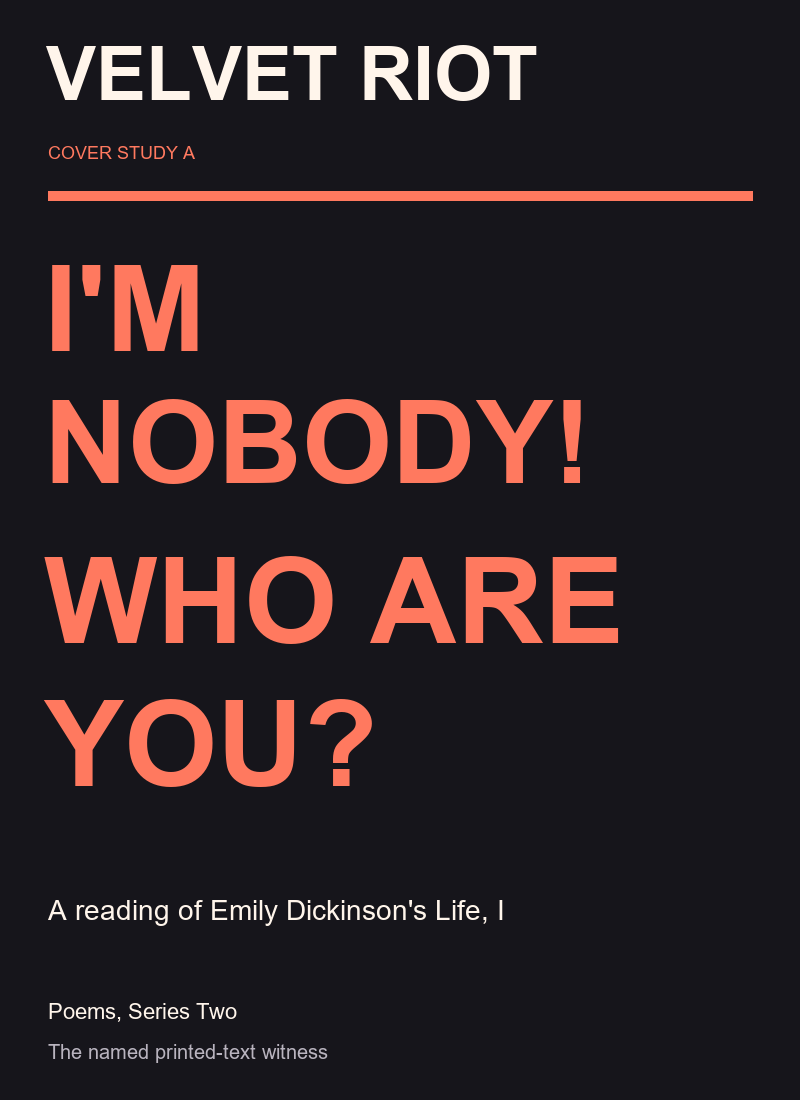
Study A places a cream masthead on a dark field, followed by a coral rule and four enormous lines: I’M / NOBODY! / WHO ARE / YOU? The poem-reading description sits near the foot. There is no portrait to identify the person behind I. At a first glance, the masthead and the declaration can read together as the publication speaking. The question then reaches out from a public object toward whoever happens to see it.
That is a real editorial possibility, not a spelling error to fix. I like the abruptness of the interrupted question: the isolated YOU? asks for an answer, while the source information arrives later. Yet the same force can recruit the reader before the feature has explained the poem’s small, guarded pair. The study borrows the opening’s energy more readily than its request for secrecy. If used, the contents would need to explore that friction instead of presenting the headline as an uncomplicated promise of belonging.
Cover B makes reading the announced activity
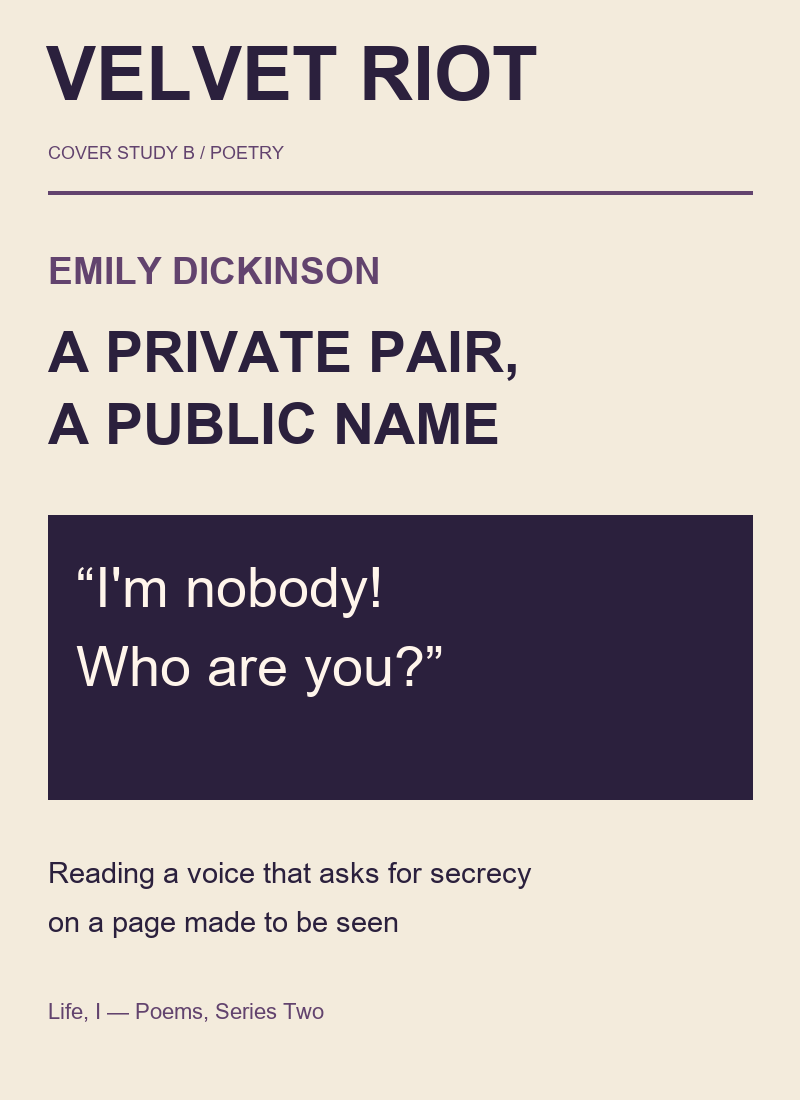
Study B keeps the masthead and page dimensions but changes the route through the words. On a cream field, EMILY DICKINSON precedes A PRIVATE PAIR, A PUBLIC NAME. The first-line quotation appears in a separate dark panel below. Two supporting lines identify the problem: reading a voice that asks for secrecy on a page made to be seen. The small bottom line locates Life, I in Poems, Series Two. This is a different complete hierarchy, not Study A with quotation marks added.
Here the publication first names a literary subject and a tension. The quoted I is more readily encountered as a voice being read, because another piece of editorial language has already introduced that activity. The reader still receives the question, but within a proposed feature rather than solely as a direct institutional challenge. The cover does not settle the poem’s meaning; it gives the ensuing reading a more specific task.
Choose the promise the feature can keep
I would develop B for this particular article. Its pair/public-name distinction can be followed through the whole short poem: possible recognition, secrecy, threatened exclusion, then the dreariness of public naming before an admiring audience. A would interest me for an essay more centrally concerned with how a magazine appropriates a first-person voice. Neither layout has been tested with readers, so this choice is an argument about the visible proposals and their contents, not a claim about sales or predictable response.
The source label also needs to remain specific. Project Gutenberg names Todd and Higginson as editors of Series Two; the preface discusses different renderings and editorial responsibility. That gives a reason to identify the text being read, not permission to reconstruct Dickinson’s final intentions. This feature keeps this witness’s banish and livelong day rather than silently replacing them with another familiar wording. It claims neither manuscript inspection nor access to an author-approved cover.
Sources & further reading
Published sources for the details and examples discussed in this story.