A notebook rarely resembles a finished creative life. Its pages can hold an unfinished sketch beside an address, a promising phrase interrupted by a shopping reminder. That mixture is worth considering before buying a perfect-looking set of creative tools. The useful question is how an object supports the work between moments of inspiration: when the desk must clear, the train arrives or an idea needs to be found again. This cover essay looks at that ordinary infrastructure, with a notebook as its starting point.
The page as a meeting place
A single book can bring different kinds of thinking into view. A drawing may answer a question left beside a paragraph; a practical measurement may make an imagined object possible. Separation can be useful, but it should have a reason. Work that needs appropriate confidentiality, a different medium or another physical setting may belong elsewhere. Merely having several interests does not require several purchases. Begin by looking at what you write, where you write it and which pages you return to. The pattern of use can be more informative than the categories printed on a stationery display.
The attractive object and the working object
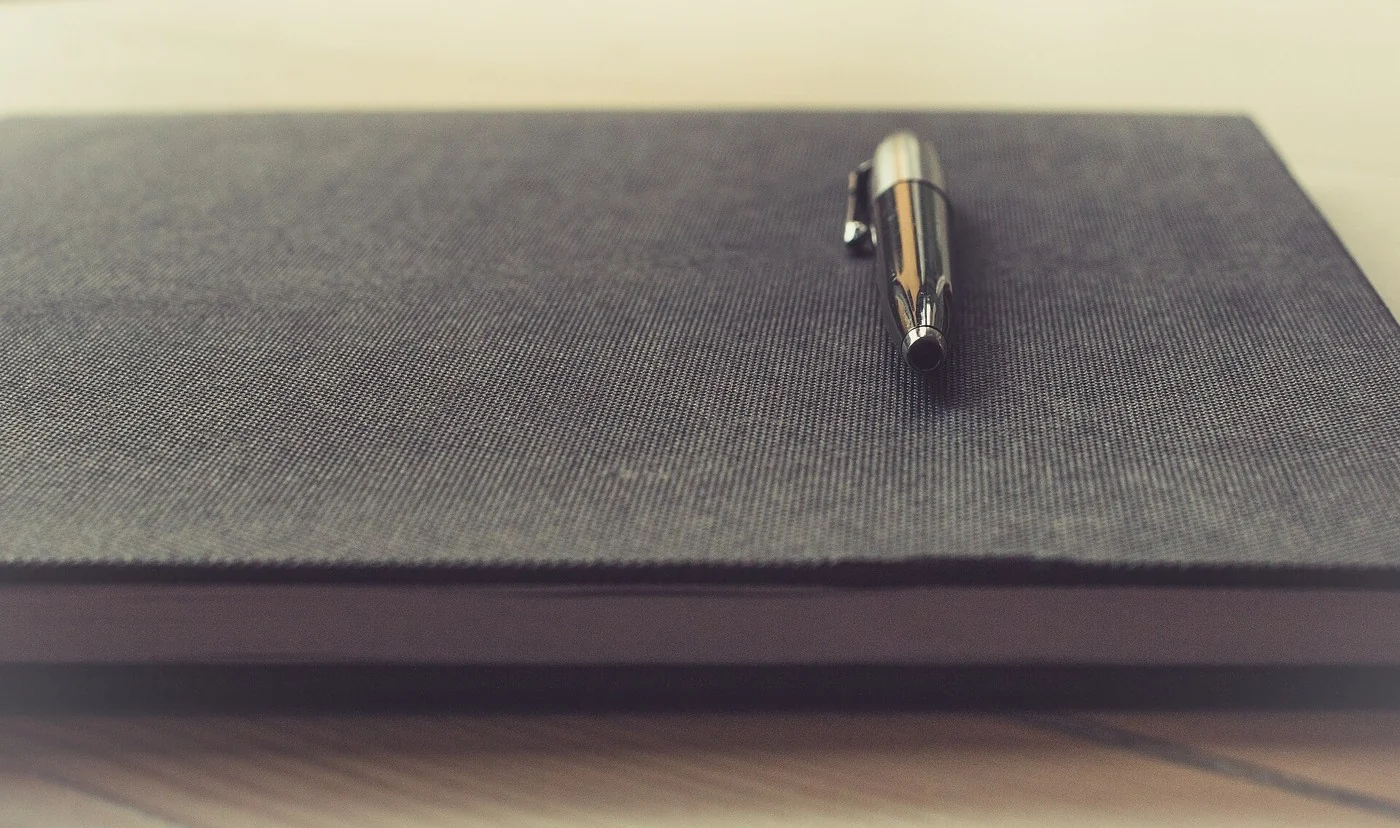
A beautiful cover can make a notebook a pleasure to pick up. That pleasure is a legitimate part of a purchase, but it does not settle whether the book works. Hold it open at the size of the desk or bag it must share. Consider whether the binding suits the way you write and whether the page surface works with the actual tools you use. Try a sample where available and permitted, or begin with one book rather than a large set. The right object can be visually distinctive and practical at once; neither quality needs to serve as an excuse to ignore the other.
A creative routine has a return journey
Capturing an idea is only part of keeping it. The next encounter may come a week later, after several unrelated tasks have entered the same book. A short heading, a date and a simple index can help a page become findable. These are editorial suggestions, not a guaranteed productivity method. Test them with an existing notebook before choosing another system. If a subject continues elsewhere, leave a cross-reference you will understand later. A shelf of coordinated volumes cannot supply that connection on its own. Retrieval is part of the work, even when it looks less romantic than the first handwritten line.
Buying room for the unfinished
Some tools remove a recurring obstacle: a page that is too small, a case that leaves pencils exposed or a book that will not fit the route between home and a shared workspace. Others introduce a new task of their own. A large drawing set needs storage, a specialized surface may need different materials, and a second notebook requires another place to search. Describe the obstacle before describing the desired product. A modest purchase can then have a clear job. Buying nothing can also be a considered outcome when the current object is serviceable and the difficulty lies in a routine that has not yet been tried.
What permanence can reasonably mean
Not every working page needs to become an archive. Some notes exist to help the next decision and can be handled within the record practices appropriate to their contents. Other pages may be worth keeping. For those, look for actual material information rather than relying on a reassuring adjective. The Library of Congress notes that archival is not a legally defined term in the context of collection housing. Ask specific questions about supplies intended for long-term storage, and seek appropriate advice for valuable originals. A decorative word should not replace the more ordinary questions of where an object will live and how it will be handled.
An infrastructure that leaves space for the work
A useful creative kit can be described plainly: the book used on the move, the tools that fit its pages and the place they return to afterward. It can change as the work changes. Review a finished volume before automatically buying its replacement. Which pages were useful, which tools remained untouched and what repeatedly interrupted a session? Keep the answers small enough to act on. The object does not have to represent every aspiration at once. It earns its place by being available for the next real act of attention, with enough character to enjoy and enough practicality to remain part of ordinary life.
Sources & further reading
Published sources for the details and examples discussed in this story.