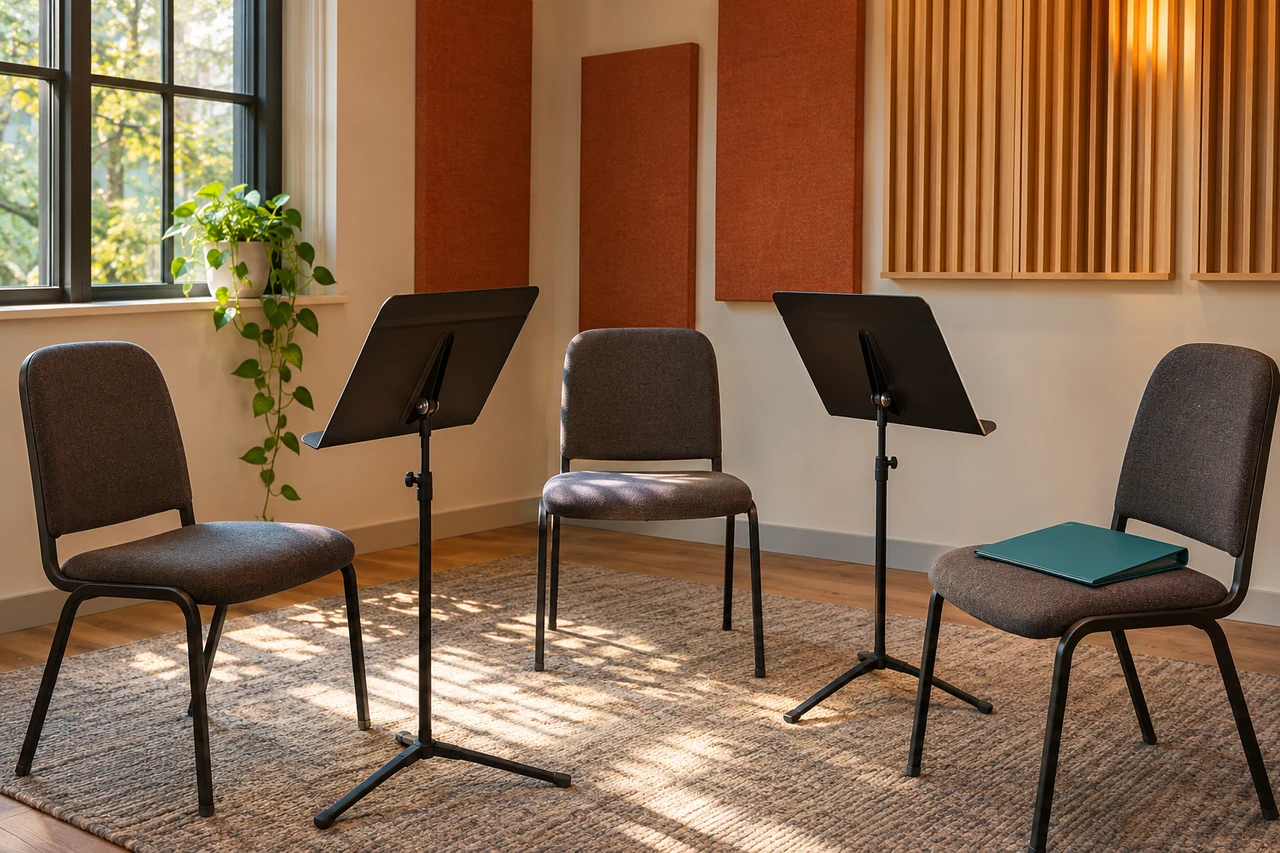
“Again, but better” leaves a group with an instruction and no shared task. A useful rehearsal request identifies the passage, the people concerned and the change being attempted. ConductIT’s communication lesson recommends waiting until playing stops, checking the relevant detail and giving information in the order of who, where and what. The complete fictional exchange below adds a clear restart agreement. No rehearsal or performance has been carried out.
Declare the invented passage first
Imagine a trio consisting of a singer, keyboard player and percussionist. Their own working outline calls one section Bridge and the next Final Verse. These are invented labels, not references to an existing composition, score or recording. In this scenario, they want the singer’s entry at Final Verse to follow a deliberately agreed transition.
Before proposing a change, the fictional leader waits for everyone to stop and checks the outline. The question is communication, not a claim that a particular count, gesture or instrumental technique will suit all ensembles. An actual group would need its own music, leader and appropriate rehearsal practice.
Name one change without hiding the location
The original request can read: “Keyboard and percussion, at the transition from Bridge to Final Verse, please leave the agreed space for the vocal entry. Let us check exactly where that space begins before restarting.” It identifies the recipients and location before the proposed change. It does not ask the singer to guess what the accompaniment will do.
The keyboard player then asks: “Do you mean the space after Bridge ends, with the singer entering before our next phrase?” The leader answers: “Yes, that is the transition I mean. Let us mark that shared intention in our own outline.” This invented clarification settles the intended relationship in words; it does not establish that the musicians can already execute it.
Set the restart boundary as well as the change
Now the leader proposes: “We will begin at the start of Bridge and stop after the first phrase of Final Verse. I will give the agreed start cue when everyone is ready. Is that the same place in each person’s outline?” Each player checks rather than treating an ambiguous nod as a complete agreement.
If someone has different section labels, resolve that discrepancy before playing. The group also needs to agree what its actual start cue means. This article specifies neither a conducting gesture nor a count-in: teaching those would require a different task. The completed communication plan has a starting point, an ending point and one transition to investigate.
Leave the musical result for the actual attempt
After a real attempt, a useful question would be whether everyone recognized the intended entry and boundary. The answer remains open here. Do not describe a smoother performance or successful cue merely because the fictional discussion sounds clear on the page. Agreement is preparation for playing, not a substitute for hearing what happens.
A plain shared outline can hold the section names and agreed change. Before buying rehearsal software, identify whether the difficulty is locating the passage, understanding the request or following an actual cue. A new tool cannot supply the conversation that has not occurred. Keep the next request attached to an observed result and let the musicians play between discussions.
Sources & further reading
Published sources for the details and examples discussed in this story.