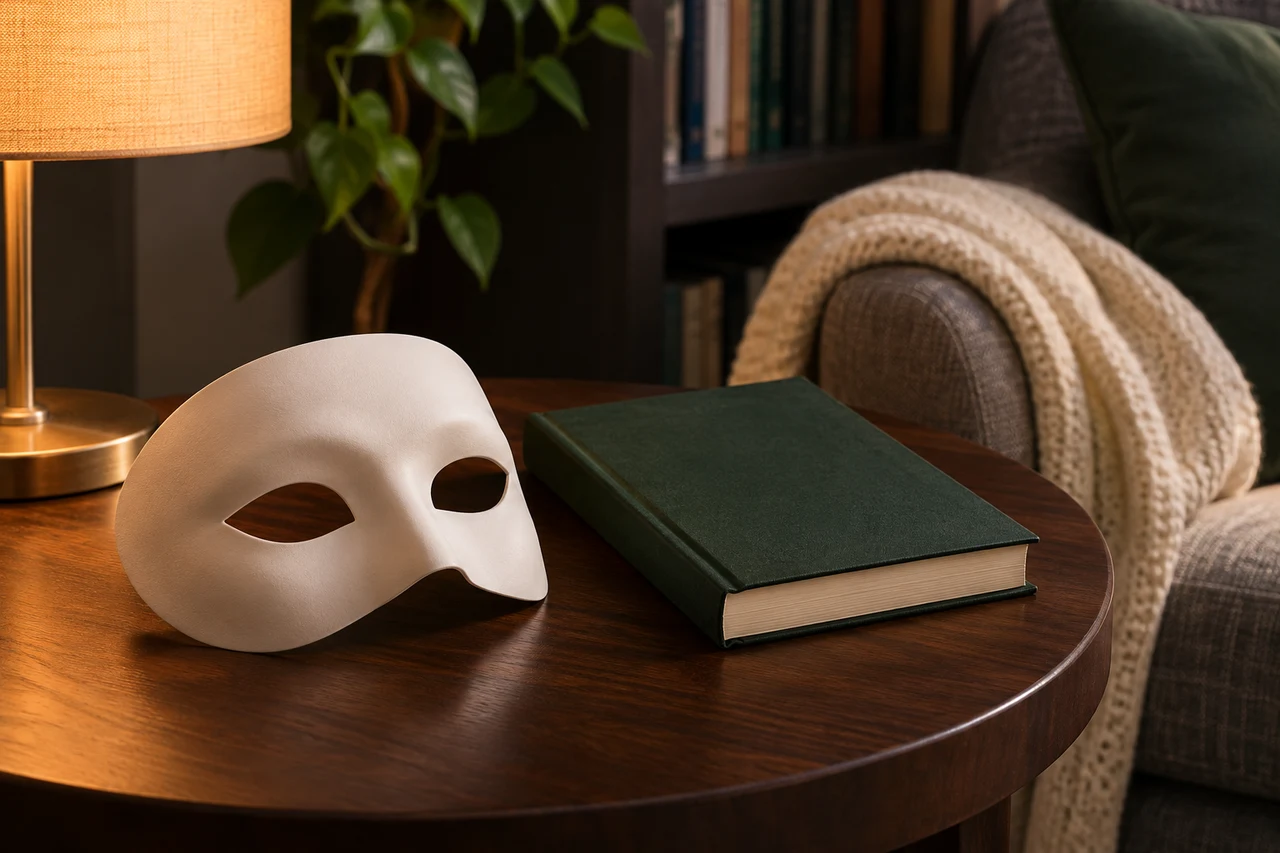
The mask in Paul Laurence Dunbar’s We Wear the Mask performs a public expression while the poem tells us that expression is incomplete. Reading all fifteen lines in the Academy of American Poets transcription, I am struck by the changing audience. The world is allowed one view, while another address carries what that view conceals. The returning refrain holds those audiences together without making them know the same things.
The plural voice describes its own public face
The opening does not introduce a solitary wearer whose identity a reader must solve. A plural voice names the mask and describes what it does. Its expression is active, while cheeks and eyes are hidden. The poem therefore establishes a difference between what can be seen and what the speaking company says about that visibility.
The following smile does not remove the injured hearts named beside it. I read the two together, rather than treating the smile as a contradiction that makes one description false. A public expression and a concealed condition can occupy the same sentence. This interpretation concerns the poem’s arrangement; it does not diagnose a speaker or identify the author’s private experience.
The question refuses a spectator’s full accounting
The middle movement asks why the world should know so much about the tears and sighs. That question changes the reader’s position. We have been told something about concealment, but the poem does not simply offer the watching world unlimited access to everything beneath it.
The instruction to let that world see only the outward performance makes withholding part of the voice’s agency. My reading note would distinguish disclosure to the poem’s reader from the public visibility being described within it. Those are related positions, but they are not automatically the same audience. The short refrain closes this movement without resolving the distance between them.
An address opens beyond the watching world
The last movement retains the smile, then turns toward Christ with the cries of tortured souls. I hear a change in addressee, not a sudden claim that the earlier public performance has ended. The world’s view remains limited while another address carries what the smile does not say to it.
Singing also arrives beside difficult ground and a long journey. In this sequence, a song is not sufficient evidence of ease. Yet the article need not import the argument of Dunbar’s separate Sympathy poem to explain this one. Here, the public face, the withheld knowledge and the direct address have their own order and their own returning phrase.
Hear the last refrain with both audiences present
The closing allows the world to imagine otherwise and repeats the mask statement with a stronger final punctuation. I read that return as carrying more than the opening definition now: the intervening question and address have shown what the outward view does not contain. The same short phrase reaches the end with a changed context.
For discussion, keep the complete poem available rather than presenting the opening smile as an inspirational caption. The Academy identifies this text as public domain; no modern commentary, portrait or recording is reproduced here. An edition earns attention through its actual text and editorial contribution, not merely an appealing mask on its cover.
Sources & further reading
Published sources for the details and examples discussed in this story.