
A path tells you where a group might travel, while an orientation tells you which way its members might face. These two original diagrams separate those decisions for an imaginary nontechnical movement scene. Four numbered markers share one clockwise circuit and a spectator side at the bottom of the page. Brown arrows point inward in one plan and outward in the other. The diagrams are conceptual drawings, not choreography instructions, a scaled floor plan or records of a performance.
Read the two kinds of arrow separately
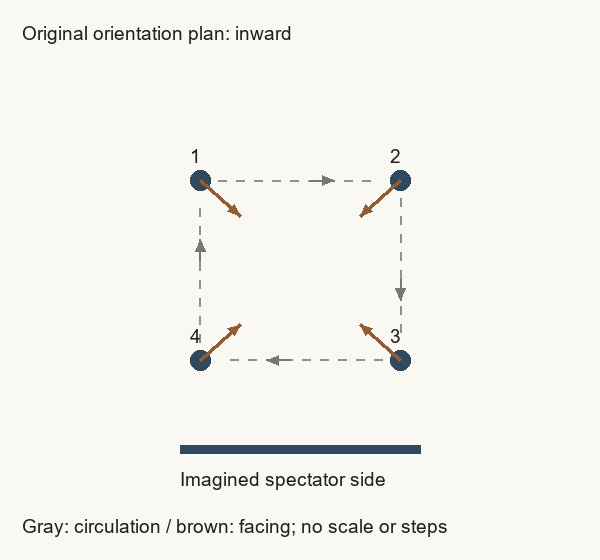
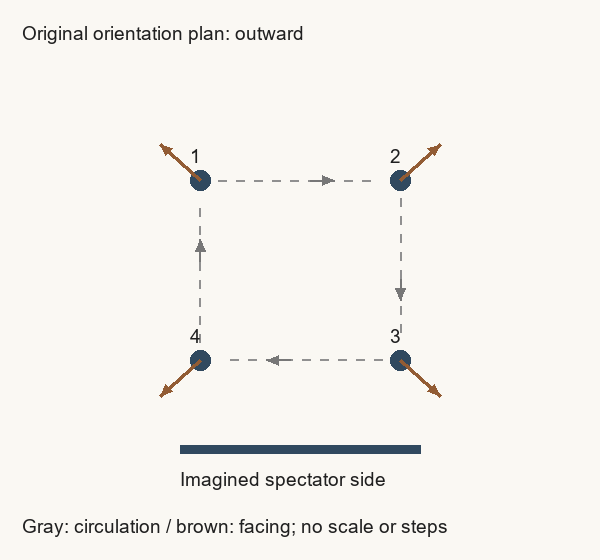
Gray dashed lines connect marker one to two, two to three, three to four and four back to one. Their gray arrowheads indicate the proposed order of circulation. They do not specify a step, speed or duration. The same circuit appears in both drawings, so changing the facing arrows does not quietly introduce another route.
The shorter brown arrows represent orientation relative to the center. They are not additional travel paths. Inward means toward the middle of the four-marker arrangement; outward means away from it. How a real person could coordinate traveling and facing would need actual creative and practical development. Nothing in these drawings establishes that a proposed action is appropriate for a body or a room.
Inward: make the middle a shared reference
In the first drawing, all four brown arrows point toward the central opening. I read that as a proposed relationship among the group’s members: each orientation acknowledges the same middle rather than presenting every person toward the spectator side. The empty center becomes part of the arrangement without containing an additional object.
The lower pair, markers three and four, point away from the spectator side and into the group. The upper pair, one and two, point across the center in directions that have a component toward that side. These are positions in an overhead drawing, not a report of which faces an actual audience would see. No bodies, heights, lighting or occlusions have been modeled.
For an imagined scene about keeping a small shared question within a group, I would investigate this inward proposal first. That is an interpretation of the orientation plan. It does not establish emotional intimacy or require participants to maintain eye contact.
Outward: give the perimeter more directions
In the second drawing, the brown arrows reverse while the four markers and gray circuit stay fixed. The lower pair now point outward with a component toward the spectator side. The upper pair point away from that side. The drawing does not make all four orientations front-facing merely because they face outward.
I read the outward version as an opening toward several surrounding directions rather than a single shared middle. It could be interesting for an invented scene where a group attends to different parts of an imagined perimeter. It does not prove that an audience would feel included, or that moving people should address every side of a room equally.
Keeping the spectator bar in the same place makes this comparison specific. If the imagined audience surrounded the circuit instead, the same orientation arrows would have another relationship to viewers. That would be a third proposal, not a hidden assumption that the two present plans already solve.
Choose a relationship before choosing a venue picture
Getty’s account of space includes the organization of the picture plane and the area around primary objects. That general vocabulary supports reading the two drawings as relationships. It is not being cited as a dance technique, a crowd-management assessment or evidence that one physical movement pattern will be safe.
For a small original creative project, the useful choice here is whether the center or the surrounding directions should organize the proposed scene. I would keep the inward plan for the shared-question idea and retain the outward plan as a distinct alternative. A real realization would then need people, access needs, surface conditions, timing and actual space addressed on their own terms.
There is no reason to buy a costume, a projection backdrop or a venue image to hide an undecided relationship. The two diagrams already make the difference inspectable before such purchases. They also make a limit clear: a compelling plan on a page does not establish a workable performance. No one has rehearsed or watched either scene for this feature.
Sources & further reading
Published sources for the details and examples discussed in this story.