A scene can propose a new center of attention without asking the editor for another cut. One original fictional two-person scene uses three successive positions within an imagined fixed view. Its overhead diagrams show where Ada and Min might stand relative to a table, doorway, window and camera. They are planning drawings, not movie frames. No set, performance or camera test has established how the finished scene would actually appear.
Give the fixed view enough room for a change
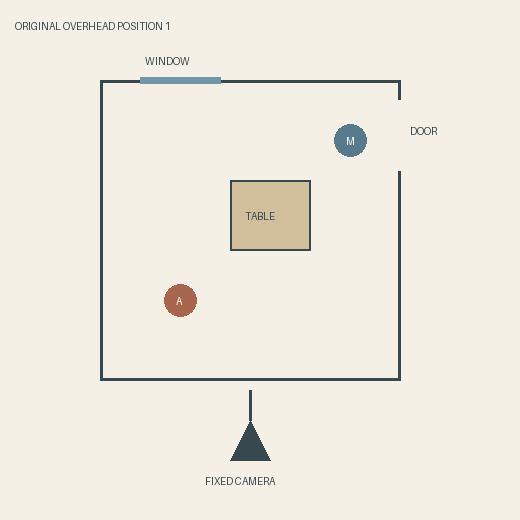
Assume one continuous imagined view contains both people and the room’s table, doorway and window. The camera marker stays at the bottom of all three plans, pointing toward the upper wall. It represents a constant proposed viewpoint, not a lens specification or a calculated field of view.
Ada is deciding which ordinary papers to take away. Min has arrived to ask what should remain. The papers are not drawn as a readable document, and no real person’s decision is being reported. This small fictional situation gives the positions a purpose without requiring a plot borrowed from an existing screenplay.
Yale’s Film Analysis guide discusses the relation of near and distant elements within represented space. That provides vocabulary for considering depth. It does not certify that our floor positions will produce a particular projected size or a successful performance in an actual shot.
Position one: let Ada occupy the nearer part of the plan
At the beginning, Ada’s marker sits in the lower-left part of the room, closer to the camera marker. Min is farther back on the right, near the doorway. The table lies between their areas rather than placing them side by side.
My intention would be to begin with Ada’s ongoing decision while keeping Min’s arrival available in the same view. This is not the same as declaring that Ada must dominate every viewer’s attention. An actual performance, costume, light or framing choice could give the farther figure considerable presence.
A useful planning question is what the second person can do while the first is the proposed focus. Min need not be frozen into a background sign. The scene can leave room for waiting or looking without inventing a cutaway simply to confirm that another person is there.
Position two: let Min join the near space
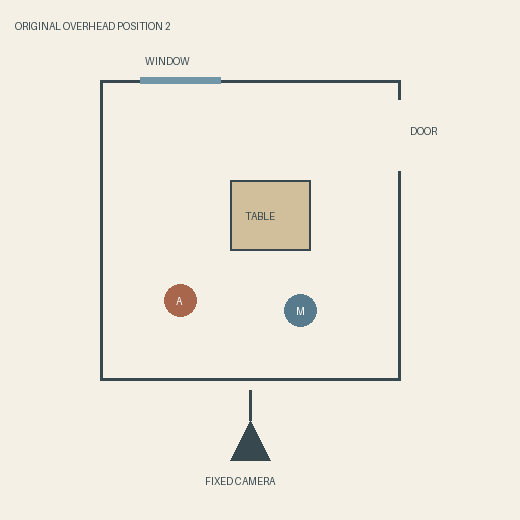
For the second position, Min moves toward the lower-right part of the room while Ada remains in place. The diagram now places both people in the nearer area, on opposite sides of the frame’s proposed center. The table and camera have not moved.
Min’s original line could be: “What would you like to keep here?” Ada might answer: “I’m still deciding.” These are fictional dialogue proposals, not a transcript. They give the movement a possible conversational function rather than treating it as a walk performed only to display a floor plan.
The intended shift is from one person’s activity with an arrival behind it to a more immediate exchange. No cut is added between those arrangements. Whether the actual exchange directs attention as intended would need to be assessed in a real staged and viewed version.
Position three: keep Min near as Ada moves back
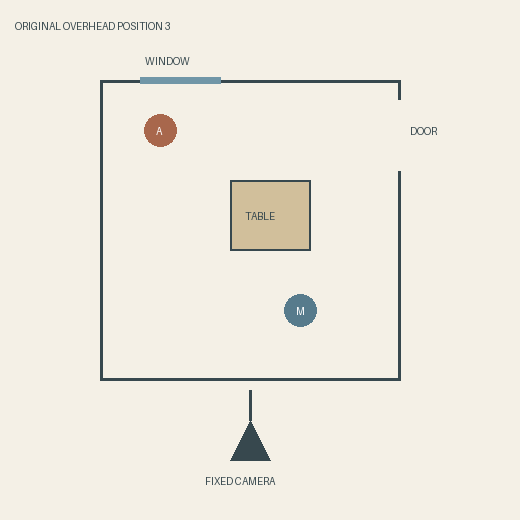
In the last plan, Min remains in the lower-right area. Ada moves toward the upper-left part of the room, near the window. Their depth relationship is now different from the beginning: the person who started nearer is farther away, and the arriving person occupies the near area.
I would use that reversal if I wanted the scene to end with Min present in the space Ada had initially led. It could make the separation worth noticing without explaining what Ada feels. Moving toward a window does not automatically mean withdrawal, refusal or a change of loyalty. The rest of a created scene would need to make any such reading accountable.
The three plans preserve an ordinary open area around the drawn table, but they provide no real route clearance or performance-safety assessment. Markers and a rectangle cannot establish suitable movement for actual people, equipment or a location.
Ask whether the cut would add a different idea
Before proposing coverage or buying production equipment, identify what remains unresolved in the continuous arrangement. Is it the important action, a line’s meaning or a relationship the fixed view does not make available? A cut could be useful for a specific reason, but it need not be the first response to every change in who speaks.
For this paper scene, the depth reversal is the idea I would investigate first. The diagrams have made it discussable without pretending it has been filmed. An actual production would still need appropriate planning, consent, access and genuine viewing of the result before describing its effect as achieved.
Sources & further reading
Published sources for the details and examples discussed in this story.