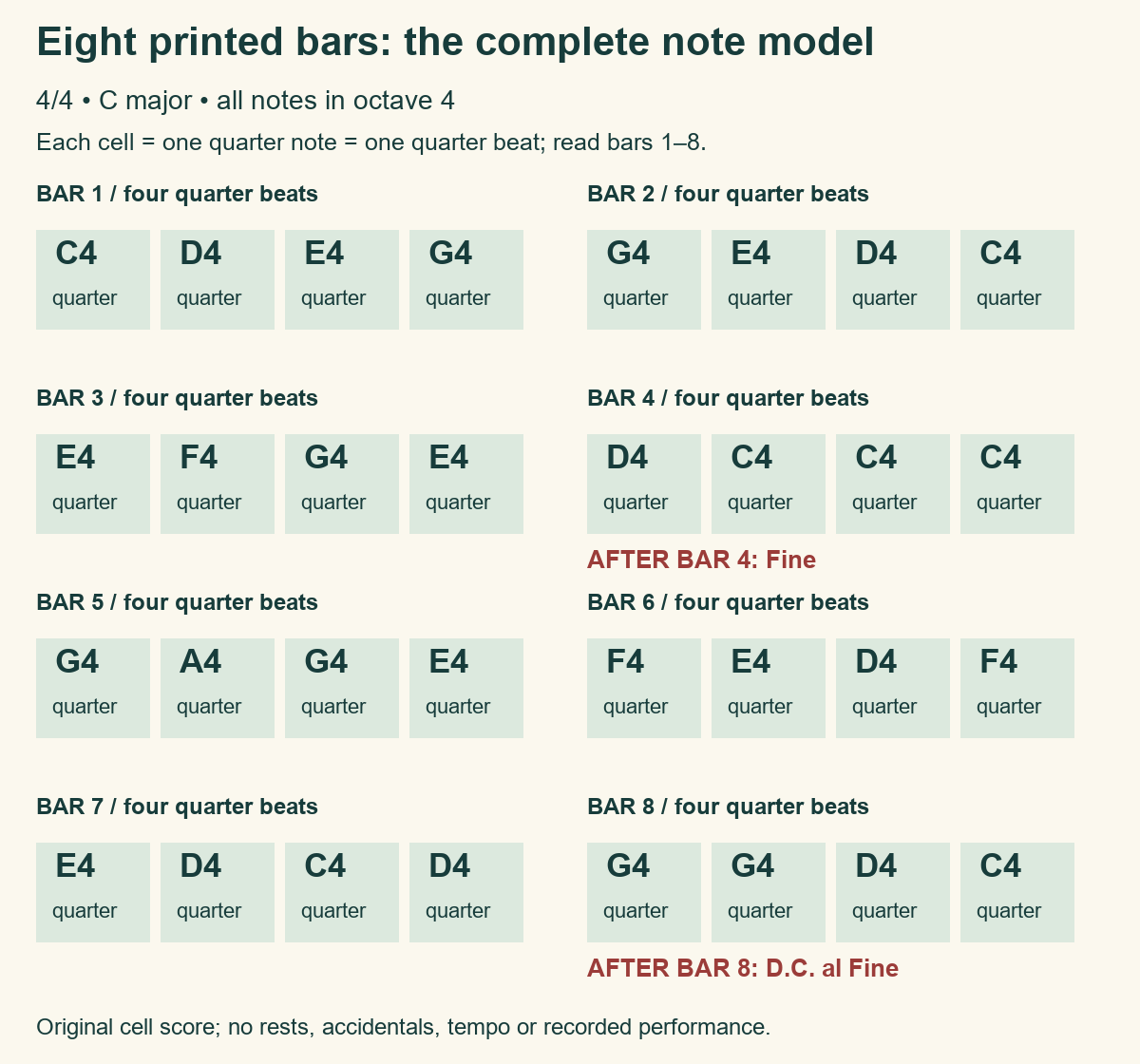
Eight printed bars do not always mean eight bars to read through once. A jump instruction can send you back to material already on the page, while another mark tells you where that return ends. This original example puts Fine after bar four and D.C. al Fine after bar eight. It supplies every pitch and duration, so the route can be checked on paper without playing a recording or opening a notation program. The task is to follow the instructions, not to recognize whether a musical idea sounds familiar.
| Printed bar | Four quarter notes, in order | Instruction after bar |
|---|---|---|
| 1 | C4 · D4 · E4 · G4 | Continue |
| 2 | G4 · E4 · D4 · C4 | Continue |
| 3 | E4 · F4 · G4 · E4 | Continue |
| 4 | D4 · C4 · C4 · C4 | Fine |
| 5 | G4 · A4 · G4 · E4 | Continue |
| 6 | F4 · E4 · D4 · F4 | Continue |
| 7 | E4 · D4 · C4 · D4 | Continue |
| 8 | G4 · G4 · D4 · C4 | D.C. al Fine |
Begin with all eight bars in view
The model uses 4/4: four quarter-note beats in each bar. Every cell contains one quarter note, and every pitch name includes octave four. C4 and C4 are therefore the same specified pitch wherever they recur. The cells are a compact letter-based score, not isolated fragments of a melody whose missing notes the reader must guess. There are no rests, changes of meter or extra repeat signs in this example.
Bars one and two use C4, D4, E4 and G4 in different orders. Bars three and four introduce F4 and settle repeatedly on C4. The second half includes A4 in bar five, then proceeds through the remaining written cells to bar eight. The complete list stays in the table as well as the diagram. Read four cells inside each bar before considering the instruction placed after it.
On the first pass, reach the jump before returning
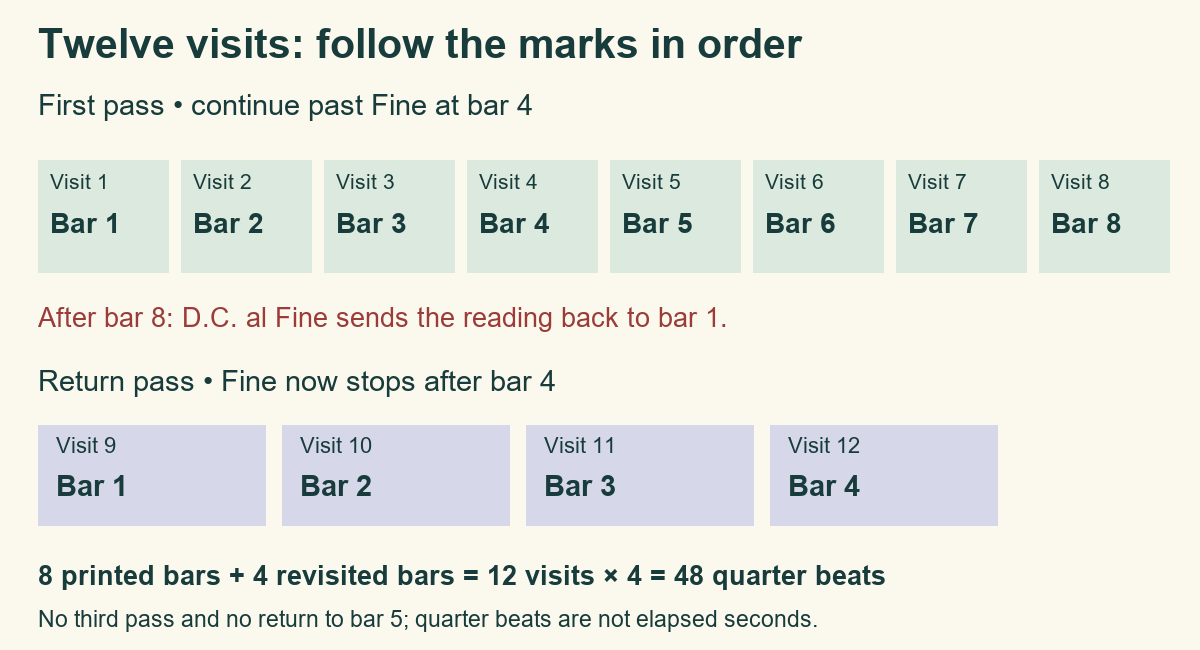
Start at bar one and proceed through bars two, three and four. Fine is visible after four, but this is not yet the return pass. The MuseScore Studio handbook explains Fine as an endpoint used with D.C. al Fine or D.S. al Fine and describes these markers as taking effect after a jump. In this model, stopping immediately at the first Fine would prevent you from reaching the command that gives it its role.
Continue through five, six, seven and eight. Only after the four notes of eight do you encounter D.C. al Fine. The handbook defines that instruction as returning to the beginning and continuing until Fine. Here beginning means bar one, not the start of the second row of cells or the last place where a similar pitch appeared. Mark the end of the first pass before moving your reading position.
The return ends after four, not after eight again
Read bars one, two, three and four a second time. At the end of four, Fine now supplies the stopping point for the return requested at eight. Do not continue to five. Nor should you jump back a third time: you have already stopped before reaching the later D.C. command again. The full visit order is one through eight, followed by one through four.
The numbered trace distinguishes the printed bar number from the visit number. Visit nine reads printed bar one; visit twelve reads printed bar four. That small distinction prevents a misleading rewrite in which four new bars seem to have appeared on the page. The notes are revisited, not newly printed. If your trace ends at eight after the return, it has ignored Fine; if it ends at four before the jump, it has applied Fine too soon.
Count the route without inventing its duration
There are thirty-two printed quarter notes: eight bars with four notes each. The return revisits sixteen of those notes, giving forty-eight note events and forty-eight quarter beats along the complete route. Equivalently, twelve bar visits multiplied by four quarter beats gives forty-eight. The extra reading comes from the first four bars, not from stretching the duration of each written note.
Those counts do not supply forty-eight seconds. No tempo has been specified, and no playback has been timed. Keep the unit quarter beat attached to the result. For checking the page, write the two passes on separate lines, then underline the last bar of each: eight triggers the jump, while four ends the return. Each mark now has a distinct job that can be checked against the complete cells rather than remembered from an arrow alone.
This model isolates D.C. al Fine. Another page may contain different jumps, markers or repeat instructions, so transfer the habit of reading the actual marks rather than transferring this twelve-visit answer to every piece. For this page, the finished route is fully determined: eight printed bars, twelve visits, then a stop at Fine.
Sources & further reading
Published sources for the details and examples discussed in this story.