A person need not walk across a room for an edit to connect them with someone on the other side. Three original storyboard frames keep Lin and Esme seated in fixed positions, then propose two closer views with opposed look directions. The drawings make the relationship visible as a plan. They are not frames from a film, a staged performance or evidence that an audience has interpreted the exchange as intended.
Give the look a place before separating the views
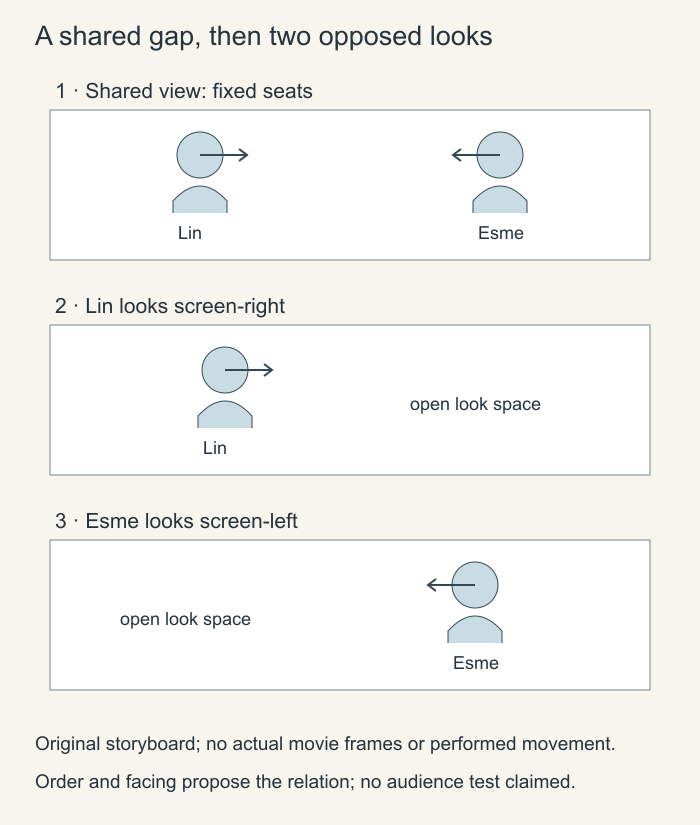
Frame 1 is a wide schematic view. Lin sits on the left and Esme on the right, with an empty interval between them. Both are drawn facing toward that interval. The drawing gives their proposed relationship one shared space before either closer view isolates a face.
The situation is deliberately simple: Lin wants to know whether Esme has finished reading a note. No readable document or real correspondence is included. In this fictional moment neither person changes seats. Keeping the positions fixed means that the difference between frames will come from the proposed viewpoints and their order, rather than a movement invented between them.
The wide view is not a scale plan. It establishes left and right within the storyboard but does not specify a lens, camera distance or shooting location. Those decisions would need their own work before an actual production.
Let the next two frames point toward one another
Frame 2 shows Lin more closely, looking to the right of the frame. There is open space in front of that look. Frame 3 shows Esme more closely, looking left, again with open space ahead. The separate drawings therefore give their looks opposed screen directions rather than making both faces point toward the same outer edge.
Yale's Film Analysis description of an eyeline match connects a shot of someone looking in one direction with a following shot containing what they see. It explains the reciprocal offscreen implication through its left-looking example. That vocabulary helps state the intended relationship here; no Yale film still or sequence is reproduced.
In our proposed order, Lin's rightward look can lead across the cut to Esme's leftward-facing close view. The earlier shared frame gives a reason to connect the two. I would use the sequence to keep their separation present even when the whole gap no longer fits inside a close view. That is a stated editorial intention, not a guarantee that direction alone settles every scene.
A change in order changes the question
Now read only frames 2 and 3,without the wide frame. The two directions still oppose one another, but the drawings offer less information about the common setting. A viewer could need another cue to establish where the two people are. The comparison does not prove that an establishing shot is mandatory; it identifies what our first frame was supplying.
Reverse the two close views on a separate note. Esme becomes the first looker and Lin the following destination. No chair has moved, yet the proposed entry into the exchange changes. This makes shot order a separate decision from where the characters stand or sit.
An original dialogue possibility is Lin asking, Have you finished? and Esme replying, Not yet. If that exchange is used, keep the words and the proposed looking order under review together. A reply could work differently when the first close view belongs to the person receiving the question. The storyboard does not claim one version has already produced a particular emotional effect.
Make the drawing carry a specific production question
The useful note is concise: shared view first;Lin looks screen-right;Esme looks screen-left;seats unchanged. If a later drawing reverses one face, mark the change rather than assuming the previous spatial relation still follows automatically. Compare the actual resulting sequence before describing its effect as achieved.
There is no equipment purchase implied by the three frames. Their immediate job is to let a collaborator ask whether the closer views still belong to the same proposed exchange. A real production would need suitable access, consent, staging and actual viewing; these drawings contribute one clear spatial intention to that larger work.
Sources & further reading
Published sources for the details and examples discussed in this story.