A short sentence can reach the screen before the picture changes, or arrive just after the new shot begins. That choice changes which image first accompanies the words, even if the sentence and its total display time stay the same. This original two-shot exercise holds those other decisions fixed. It is a paper timeline for editorial comparison, not finished subtitles, an accessibility evaluation or a current broadcaster delivery specification.
Give the image and the sentence one shared clock
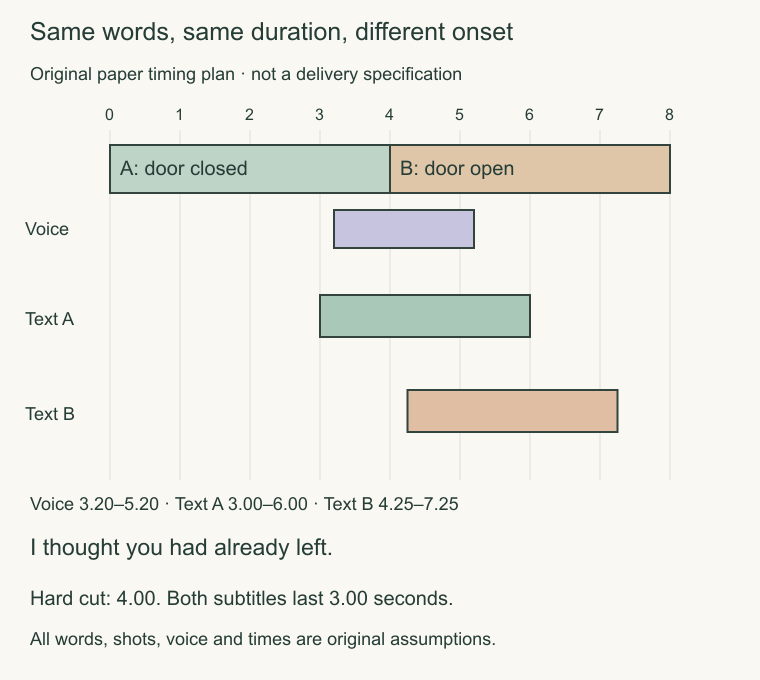
Our fictional sequence lasts eight seconds. Shot A occupies 0.00 to 4.00 seconds: a fixed view of an empty chair beside a closed door. Shot B occupies 4.00 to 8.00: the door is now open and the chair remains empty. The change at 4.00 is a hard cut. No person appears, and there is no camera movement to supply another event at the boundary.
An offscreen fictional speaker, Nia, says the original line, "I thought you had already left." For this plan, the spoken line begins at 3.20 seconds and ends at 5.20. These are assigned planning times, not measurements from a recording. Keeping the speaker offscreen avoids making one version look like a lip-synchronization test that the exercise cannot perform.
Use the same six words in a single text block for both alternatives, with the same position and appearance. Do not add a speaker label in only one version, break the sentence differently or change the door action. Those would create additional differences. The question here is what moving onset across this particular cut does to the proposed relation between words and images.
Version A puts the words under the closed door first
In A, the subtitle appears at 3.00 seconds and disappears at 6.00. It remains visible for three seconds. Its first second accompanies shot A, while its final two seconds accompany shot B. The subtitle therefore exists before the cut and continues unchanged across it. The figure shows one continuous bar, not two separate subtitle events.
Its onset precedes the assumed speech by 0.20 seconds, and its removal follows the assumed speech end by 0.80. Those differences are arithmetic descriptions of this invented timeline. They are not certified tolerances. I would notice that the sentence becomes available while the door is still closed, allowing the thought of somebody leaving to accompany that unresolved view.
At the cut, the words have not changed, but the door has. In my reading, the open doorway can make the already-present sentence feel newly pointed. That is an editorial hypothesis, not a finding about actual viewers. A viewer might instead be occupied with reading and miss the small visual change, which would be a question for a real evaluation rather than an outcome we can infer from a bar on paper.
Version B starts after the new image has arrived
In B, move the complete subtitle to 4.25 through 7.25 seconds. Its duration is still three seconds; only its position on the timeline has shifted by 1.25 seconds. It no longer appears under shot A and does not span the cut. The new picture has been present for a quarter second before the words begin.
The assigned speech still runs from 3.20 to 5.20. B therefore starts 1.05 seconds after the voice begins and ends 2.05 seconds after it stops. Moving the words away from the cut has not moved the voice. This is the important cost that a diagram focused only on shot boundaries could hide.
I read B as letting the open doorway appear before the sentence supplies a possible relation to it. Compared with A, that makes the sequence of information image first, then words. But this version leaves the beginning of the spoken sentence without its displayed text and leaves the text present after the assumed voice ends. Calling it cleaner solely because the bar avoids the cut would ignore another part of the same proposal.
Read the historical source as a tension, not a stamp
M. J. Evans's BBC R&D White Paper WHP065, dated July 2003, describes assisted and live subtitling systems. Its section1.5 discusses avoiding distracting subtitle boundaries around shot changes and expresses a preference for synchronizing boundaries with changes. The same subsection also describes balancing dialogue timing, readable display time and the grouping of words. That second part matters as much as the isolated preference.
This exercise does not claim either timeline complies with that historical discussion. A spans the cut; B begins near it and delays the assumed speech. The paper's account gives us a reason to notice competing constraints, not permission to label one bar approved. It is also not being presented as the BBC's current delivery rules or as a contemporary universal specification.
For an actual production, current destination requirements, the real soundtrack and skilled subtitle work would be necessary. The paper itself discusses the value of skilled amendment to automatically produced subtitles. Our authored words and geometry do not replace that work, and none of the BBC's diagrams, program images or example subtitles is reproduced here.
Choose what the comparison has actually established
Both alternatives supply the same text for three seconds. A gives it one second with the closed door and two with the open door. B gives it all three seconds with the open door. That is the concrete difference the figure establishes. It also exposes how the shift changes the relation to an unchanged voice, rather than making that consequence disappear from the discussion.
If the desired effect is to let the line anticipate the door change, A is the proposal I would investigate first. If the desired effect is a short uncaptioned arrival of the new image, B makes that aim visible but carries the larger speech delay. A third version would need its own declared timings; quietly adjusting the sound to rescue B would create a different experiment.
A useful editorial conversation can end with this unresolved trade-off. There is no need to pronounce either study universally better. The finished output is a complete pair of timelines whose timing, text and image assumptions another editor can inspect, challenge and change one at a time.
Sources & further reading
Published sources for the details and examples discussed in this story.