A hand leaves an envelope on a table. In the next view, the same hand returns to pick it up. A straight cut can join those actions without showing the hand outside the frame; an interval of black can make the separation conspicuous. Neither transition supplies a clock for the fictional room. These two original storyboard plans keep the actions fixed while making different proposals about the time between them.
Fix the actions before changing the join
Our invented scene has one person, Mara, a plain envelope and an otherwise empty table. Shot A lasts four seconds: the hand enters from the left, places the envelope at the center and withdraws. Shot B also lasts four seconds: the hand enters from the left again, lifts the envelope and leaves. Nothing changes on the envelope, and the lighting and camera position are held constant in the plan.
There is no film recording behind these drawings. The action descriptions and durations are the complete authored material. Keeping them explicit stops us from attributing a time signal to a changed prop, costume or sound that the exercise never supplied. The hand returning is all that happens in the second shot.
Version one: let the cut join the actions directly
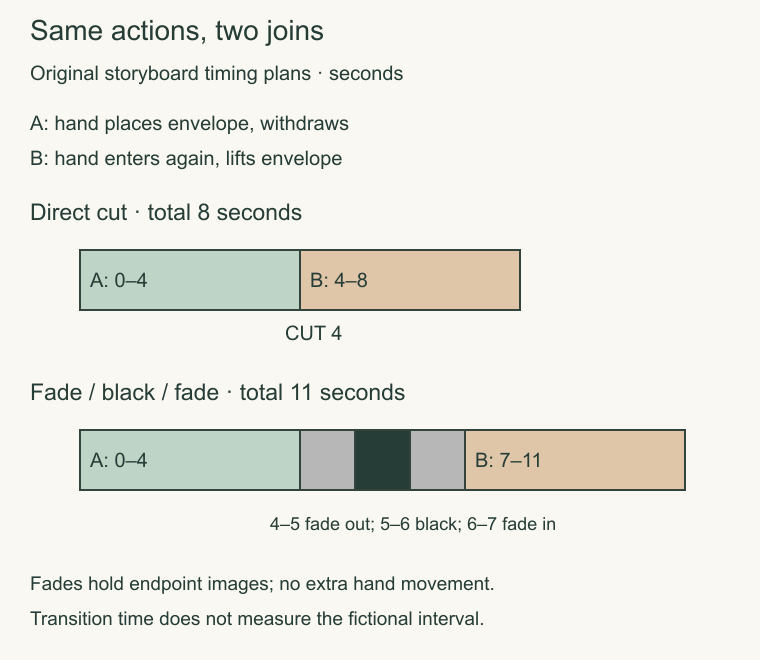
Place A from 0 to 4 seconds and B from 4 to 8 seconds. At exactly 4 seconds, the picture changes directly from the end of A to the beginning of B. No black frame, blend or inserted title appears between them. The plan therefore shows eight seconds of pictures while omitting any separate view of what Mara does beyond the frame.
I would initially propose a short, continuous action: setting down an envelope and immediately reconsidering. That is my reading of this specified join, not information carried by the word cut alone. A hard cut could also connect events separated by hours if other context established that interval. Here there is no such context, so it would be misleading to label the join proof of uninterrupted story time.
Version two: make an interval visible
Keep A at 0 to 4 seconds. Add an authored one-second fade from its final image to black from 4 to 5, hold black from 5 to 6, then fade from black into the initial image of B from 6 to 7. Play the complete four-second action B from 7 to 11. The fades hold the respective endpoint images; the hand does not continue moving inside them.
This eleven-second arrangement contains the same eight seconds of action plus three seconds of transition. Those three seconds are screen duration, not a measured absence in Mara's day. I read the interruption as making room for a hesitation or an ellipsis. It would still take another cue to establish whether the envelope waits for a minute, an afternoon or no significant fictional interval.
Compare the claim, not just the effect name
Yale's film-analysis guide discusses editing as a way to join shots and alter the relation between screen time and time in the story. That distinction is useful here. Our fade construction is a declared original choice; the guide is not being cited as a rule assigning a particular number of fictional minutes to blackness.
The figure records both complete timelines. Notice that making the fade version last eleven seconds has not added a new action. If the intended story needs an unambiguous next morning, a verified date cue in an actual production might matter more than lengthening the fade again. For this small study, the honest comparison is between an unobtrusive join and a conspicuous pause, with both time interpretations left accountable to what the images actually show.
Sources & further reading
Published sources for the details and examples discussed in this story.