An explanation can interrupt a sentence usefully, or arrive after the paragraph has already asked the reader to understand its term. These two original versions keep an imaginary gallery visit, its information and its reader fixed. The only change is where a short definition of monotype appears. That makes the editorial choice visible without turning a newcomer into a specialist halfway through the comparison.
Hold the visit and the information fixed
Both versions describe an invented display with one print, a drawing and a letter. There is no real exhibition, curator or visitor response behind the example. The reader is assumed to be interested in art but unfamiliar with the word monotype. That same reader encounters both versions; we are not writing a simple version for one audience and an abstract version for another.
The process definition is a compact paraphrase of MoMA's monotype vocabulary: a unique print made by applying paint or printing ink to a flat plate of metal, glass or plastic. The imaginary display, its order and the proposed comparison are original. No MoMA artwork or exhibition description is reproduced.
Version A: explain at the first mention
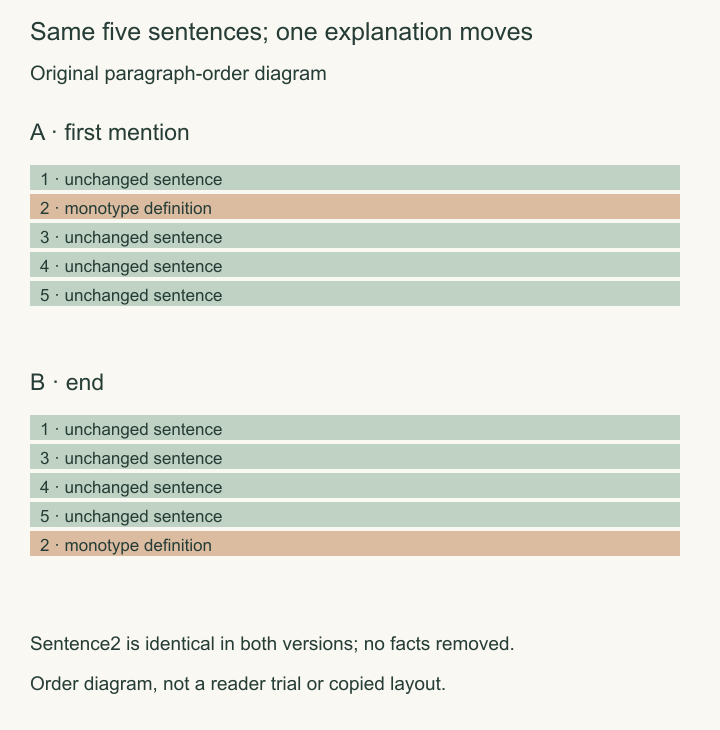
The display begins with a monotype. A monotype is a unique print made by applying paint or printing ink to a flat plate of metal, glass or plastic. Beside it hangs a drawing, and a letter occupies a separate case. The arrangement puts two kinds of image beside a written account, inviting a comparison between what the objects show and what the letter says. This is an imagined display; no actual visitor response is being reported.
Version B: explain at the end
The display begins with a monotype. Beside it hangs a drawing, and a letter occupies a separate case. The arrangement puts two kinds of image beside a written account, inviting a comparison between what the objects show and what the letter says. This is an imagined display; no actual visitor response is being reported. A monotype is a unique print made by applying paint or printing ink to a flat plate of metal, glass or plastic.
Compare the first unresolved question
In A, the unknown term appears and is explained immediately. The reader then reaches the neighboring drawing with a process distinction available: the first object is a particular kind of print. The definition briefly suspends the walk through the display, but it gives that interruption a reason at the point where the term becomes necessary.
B preserves the movement from first object to neighboring drawing to letter. Its cost is that the reader has to carry an undefined term through the proposed comparison. The final sentence then turns away from the relation between objects and words to explain a process that appeared at the beginning. I hear that as a delayed return, rather than a continuation of the visit.
Neither reaction is a measured result from readers. The complete sentences let another editor challenge the interpretation. Someone who already knows the term might prefer B's uninterrupted opening movement, but that would change an assumption of our declared exercise. We cannot use a newly imagined expert as proof that the original unfamiliar reader needs no explanation.
Count the information before judging the rhythm
Each version contains the same five sentences, with the definition sentence moved and everything else retained. Both say where the monotype, drawing and letter are placed; both propose a comparison; both identify the display as imaginary. No detail has been deleted to make one version seem quicker or added to make the other appear more informative.
The Writing Center at UNC connects decisions about inclusion and organization with the intended reader's knowledge. Our example keeps that general question small: one unchanged explanation, two locations. Its handout has not been copied, adapted into a worksheet or presented as evidence that this placement has been tested.
Choose the ending you want to leave
I would choose A for this declared reader. Its final sentence leaves the status of the imaginary display clear, after the relation between the visual objects and letter has been introduced. B instead ends on the printmaking definition. That can make a subordinate term feel like the paragraph's final subject.
An end explanation could still be deliberate if the paragraph's purpose were to move toward that term. Our existing paragraph does not do that: it moves toward comparing images and a written account. The useful revision is therefore a placement decision grounded in this paragraph's movement, rather than a universal rule that every arts term needs a parenthesis or every definition belongs in a glossary.
Sources & further reading
Published sources for the details and examples discussed in this story.