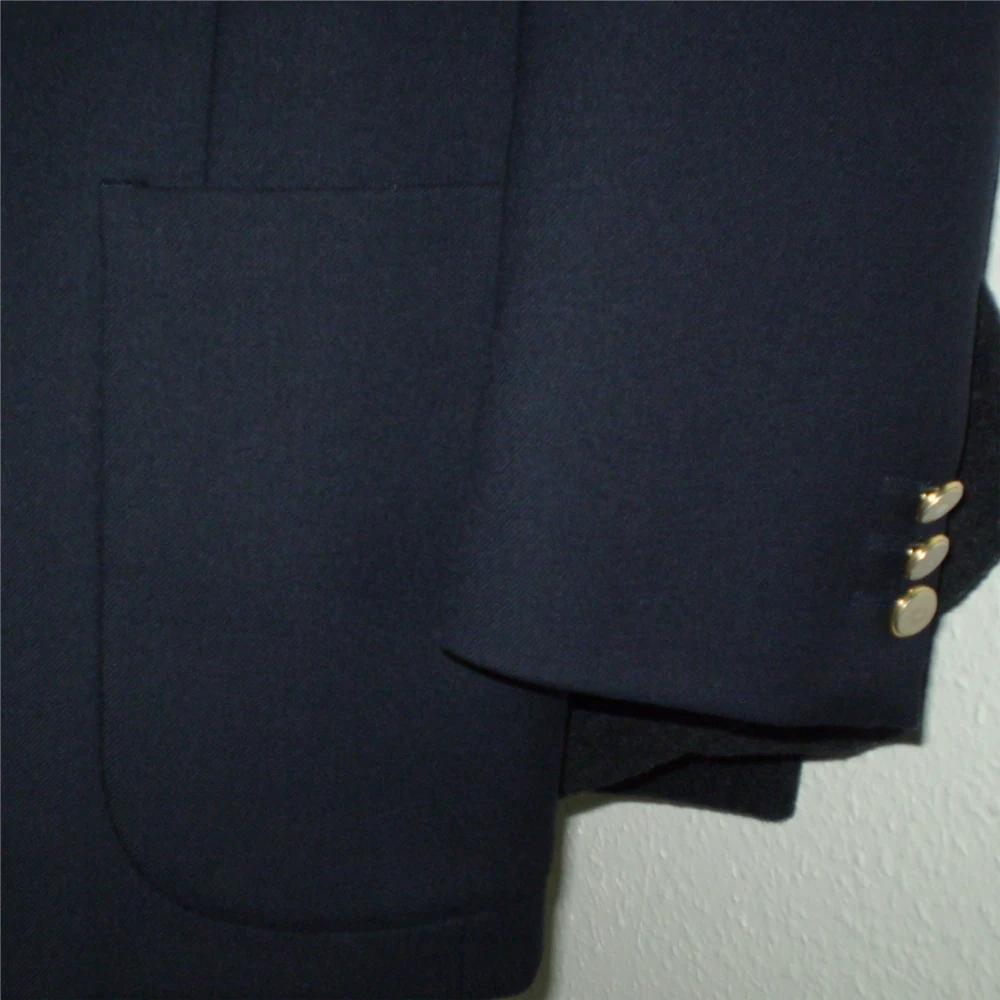
A pocket can change a jacket drawing without changing its outside silhouette. In this original study, the same rectangular patch pocket appears at three heights on one fixed flat outline. The comparison treats the pocket as part of the visible composition, rather than evaluating whether someone can reach it or whether it can carry a load. A complete three-position set makes that local choice easier to discuss than three unrelated jacket photographs.
Make one drawing that can be copied three times
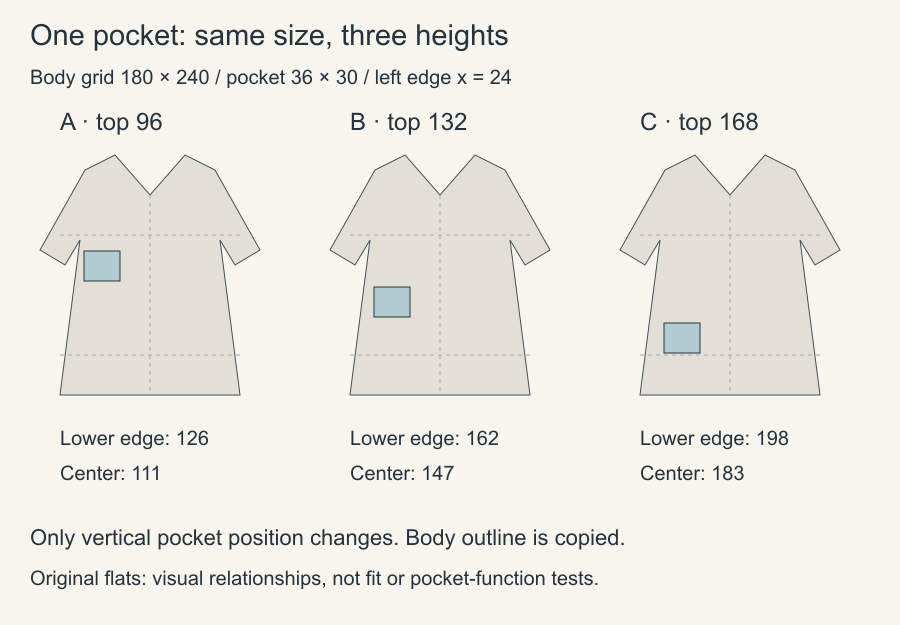
The authored jacket flat has the same shoulders, sleeves, opening, collar and hem in all three versions. Its central body drawing is 180 units wide and 240 units high. Use a reference line across it at 80 units and another at 200 units from the top. These are drawing coordinates, not a size chart or a measured garment.
The pocket is 36 units wide and 30 units high. Keep its left edge at 24 units from the left side of the body. Only its top edge moves: at 96 in A,132 in B,and 168 in C. Each move is 36 units downward, while the pocket's outline, width and height stay constant. Its lower edges are 126,162 and 198 respectively.
This controlled set matters because a new pocket shape could supply its own explanation for a change in emphasis. A dark new fabric could do the same. The three studies therefore keep line weight and colors identical. The comparison is about placement within an already declared drawing.
Read the high, middle and low relationships
InA,the top of the pocket sits 16 units below the upper 80 unit reference. The rectangle feels attached to the upper part of the jacket in my reading because its nearest marked horizontal neighbor is there. The whole jacket has not become shorter, but the additional shape gives me something to notice relatively early as I follow its front downward.
InB,the pocket occupies 132 to 162. Its center is 147,compared with 111 in A and 183 in C. I read this middle version as a pause within the longer uninterrupted front. It leaves more space above thanA and more below thanC. That is a comparison of visible intervals, not a claim that it suits a particular body type.
InC,the pocket's lower edge is 198,only 2 units above the 200 reference. It appears to join the lower part of the composition more closely. If that reference becomes a real design feature later, the near alignment could matter. For now it remains a drawing aid, not an engineered seam or proof that an actual pocket would clear a hem facing.
Keep a composition decision separate from a functional one
The Getty's formal-analysis material describes line and shape as ways of defining parts within a picture. The new rectangle gives the fixed jacket another set of edges. In this study, moving those edges changes their distance from existing features while leaving the outer contour untouched.
I would chooseA if the desired visual brief emphasizes the upper front,C if the pocket should speak more closely to the lower reference,andB if the uninterrupted spaces above and below are the main interest. Those are three explicit intentions, not a ranking in which one placement is always balanced or correct.
A real pocket would raise questions this flat cannot answer: access, hand movement, closure, attachment and the chosen material. Those questions need appropriate design and construction work. Do not select a position from the picture and call its function tested. The drawing can still make the intended visual relationship precise before that work begins.
Keep the three flats together when explaining the decision. A note reading same pocket, same outline, top edge 96/132/168 preserves what the comparison actually changed. If a later revision also changes pocket size or jacket proportions, make a new set rather than presenting it as evidence about position alone.
Sources & further reading
Published sources for the details and examples discussed in this story.