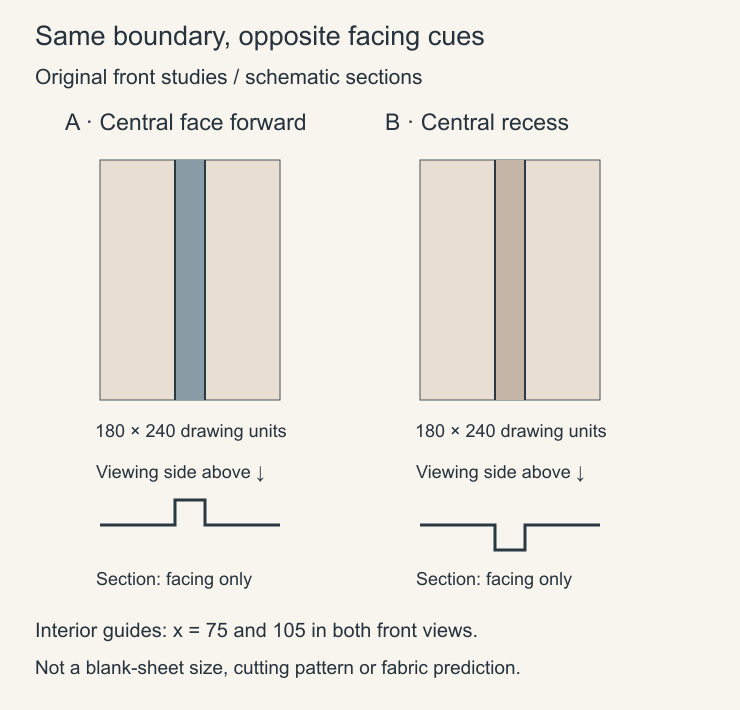
Two pleat drawings can keep the same outside rectangle while giving its center a different direction. The original studies here use a front-view panel and a separate schematic section to compare an outward-facing and inward-facing fold. The purpose is to make the surface relationship discussable before considering cloth. These are authored paper-design drawings, not a cutting pattern, a garment reconstruction or a prediction that a particular fabric will hold their shape.
Hold the boundary still
Begin each front drawing with the same 180 by 240 unit rectangle. Place two vertical guide lines at 75 and 105 units from its left edge, leaving a 30 unit central band. The units belong to the drawing grid. They are not body measurements, seam allowances or instructions for the dimensions of a blank sheet to cut.
Copy that boundary and both line positions exactly for the second study. Keep the same pale panel color and the same size of the drawing. This makes the comparison local: a change in outside width or a more dramatic color cannot explain the difference we are asking the fold direction to make.
The Getty's formal-analysis vocabulary distinguishes line direction and the use of space within a picture plane. Here those terms help name what remains fixed: the outer contour and the position of the two interior lines. The drawings then propose a different facing relationship inside that boundary, without asking a general line description to certify physical construction.
Give the two versions opposite section cues
In study A,the schematic section projects the central folded area toward the indicated viewing side. The front view marks that central band as the face brought forward. I read the center as a panel that meets the viewer before the neighboring surface. That is a description of this drawing's cues, not proof of how a finished garment would move.
In study B,the section reverses that facing relationship. Its central area goes away from the indicated viewing side, and the section makes the two surrounding lips nearer than the recess. The two 75 and 105 lines have not moved. What changes is which surface the drawing asks us to treat as forward.
Keep the section beside the front view instead of leaving the shading unexplained. A dark strip alone might be read as a color block, printed stripe or a shadow from some other object. The section supplies the intended fold interpretation. It is schematic: it does not calculate paper thickness, folded blank length, bend radius or a sewing method.
Compare one relationship instead of naming an entire silhouette
In the outward-facing study, I follow the central face as one broad strip. In the inward-facing study, I notice the two near edges framing the recess. Someone discussing the drawings can point to those same locations even if they prefer the other version or read its visual emphasis differently.
A useful annotation is therefore specific: boundary unchanged;crease positions unchanged;central face forward in A;central recess in B. That note is more informative than calling one simply stronger or more flattering. It identifies the controlled change and leaves preference as a separate judgment.
To develop the idea further, trace another pair at the same scale and change only the central-band width. That would be a new comparison, not another result already established here. Keep its drawing separate so the present pair remains a clear record of facing direction alone. Before translating either into a material object, a maker would still need an appropriate pattern and evidence about the chosen material.
The completed study is useful as a visual brief: it names the desired facing relationship without pretending that paper, silk and a finished worn garment behave alike. The two front views do not need different outside silhouettes to offer different interior readings.
Sources & further reading
Published sources for the details and examples discussed in this story.