An imagined sheer layer can introduce a second edge without erasing the first. Two original digital paper drawings explore that idea with one blue opaque shape and one translucent rectangular overlay. The overlay is a tracing-paper analogy made with digital transparency: no physical paper or textile was handled. Its usefulness is visual and limited. It lets us compare overlap and revealed boundaries without pretending to predict how a real garment transmits light, hangs or covers a wearer.
Keep the two shapes simple enough to inspect
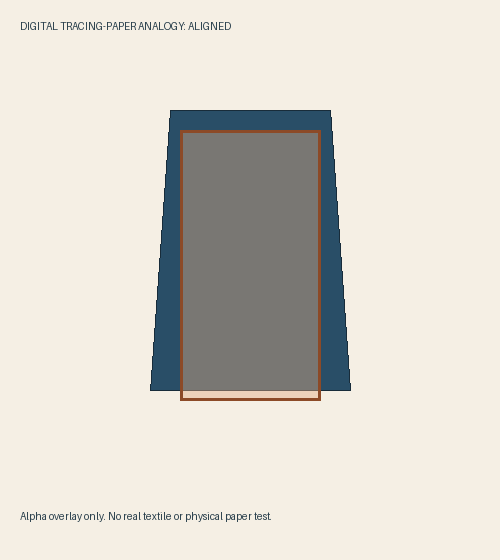
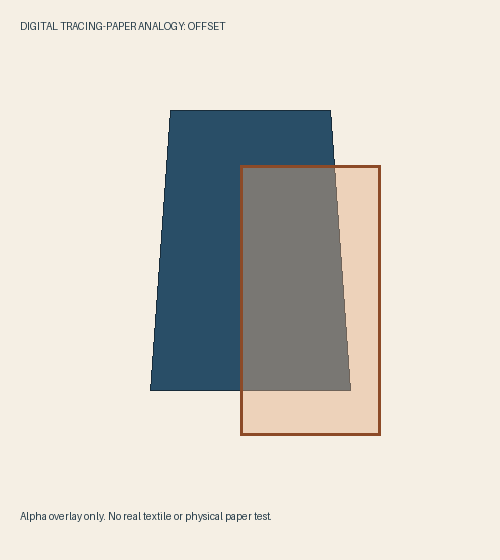
The opaque blue shape widens toward its lower edge. The translucent rectangle has a brown outline and a warm pale fill. Its dimensions and transparency setting remain the same in both drawings. We change its position relative to the blue shape, not the underlying shape’s size or the overlay’s opacity.
These marks stand for a possible layered relationship, not a garment pattern or a manufactured product. There are no seams, fastening points, arm openings or measured body beneath them. A drawn rectangle can extend beyond another shape without accounting for gravity, construction or the person who would wear actual clothing.
Getty’s vocabulary for reading line and edges helps name what remains visible. It does not turn the digital overlay into evidence about an actual fiber, weave or finish. The color of an overlap on this screen belongs to our image-generation method, not to a tested combination of textiles.
Aligned: hold the second outline near the first
In the first drawing, the warm rectangle sits within most of the blue shape’s width. Its upper edge starts below the blue top, and its lower edge extends slightly beyond the blue bottom. Narrow strips of blue remain visible along the sides. The two outlines therefore occupy similar territory without becoming exactly the same shape.
Through the digital overlay, the central blue area is still visible as a changed color. Outside the overlap, the blue remains unchanged. This makes the boundary between covered and uncovered parts easy to identify. The drawing does not show that the covered area is softer, lighter in weight or more comfortable.
I would develop this aligned version if the image brief were to keep the larger outline comparatively contained while introducing a second lower edge. The warm rectangle adds a related boundary rather than making a major sideways departure. That preference concerns this particular arrangement, not a rule that layers should always follow the same direction.
Offset: give the upper layer a different territory
In the second drawing, the identical rectangle moves right and down. Its left edge now begins around the middle of the blue shape, while its right edge reaches into the pale background. More of the blue is uncovered on the left. On the right, the warm layer continues beyond the opaque outline and becomes a distinct shape against the page.
The blue shape’s sloping right boundary remains visible through part of the overlay, then ends above the overlay’s lower edge. I find this version more explicitly about two shapes meeting. The rectangle is no longer mainly an internal frame; part of it belongs to the background beside the blue form.
That apparent extension is available in a flat drawing without being practically wearable. It provides no evidence that an actual sheer panel could maintain that position, retain a rectangular edge or reveal exactly the same amount beneath it. We have not supplied a support system, a body movement or an exposure condition.
Use a revealed edge as a question for the actual garment
My preference is the offset drawing when the purpose is to make the layered boundary the subject. The aligned version would be my starting point when the main outline should remain more unified. Neither choice requires inventing a claim about modesty, body shape or the personality of the wearer.
If a real layered item interests you, inspect the exact product information and appropriate legitimate views instead of choosing from the word sheer alone. Consider what the garment is intended to be worn with and what is actually included in the purchase. A styling photograph can show one proposed combination without establishing its behavior in every setting.
Actual coverage, construction, care and personal suitability need their own assessment. Do not use the alpha setting from a digital analogy as a percentage specification for fabric transparency. A seller’s garment image, our drawing and a wearer’s experience are different kinds of evidence; one should not silently replace another.
There may be no reason to buy a separate layer at all. The drawing earns its place by clarifying the edge relationship you want to investigate. If that relationship is not useful with actual clothing you own or an item you can assess appropriately, the paper proposal can remain an interesting image.
Sources & further reading
Published sources for the details and examples discussed in this story.